Quick answer
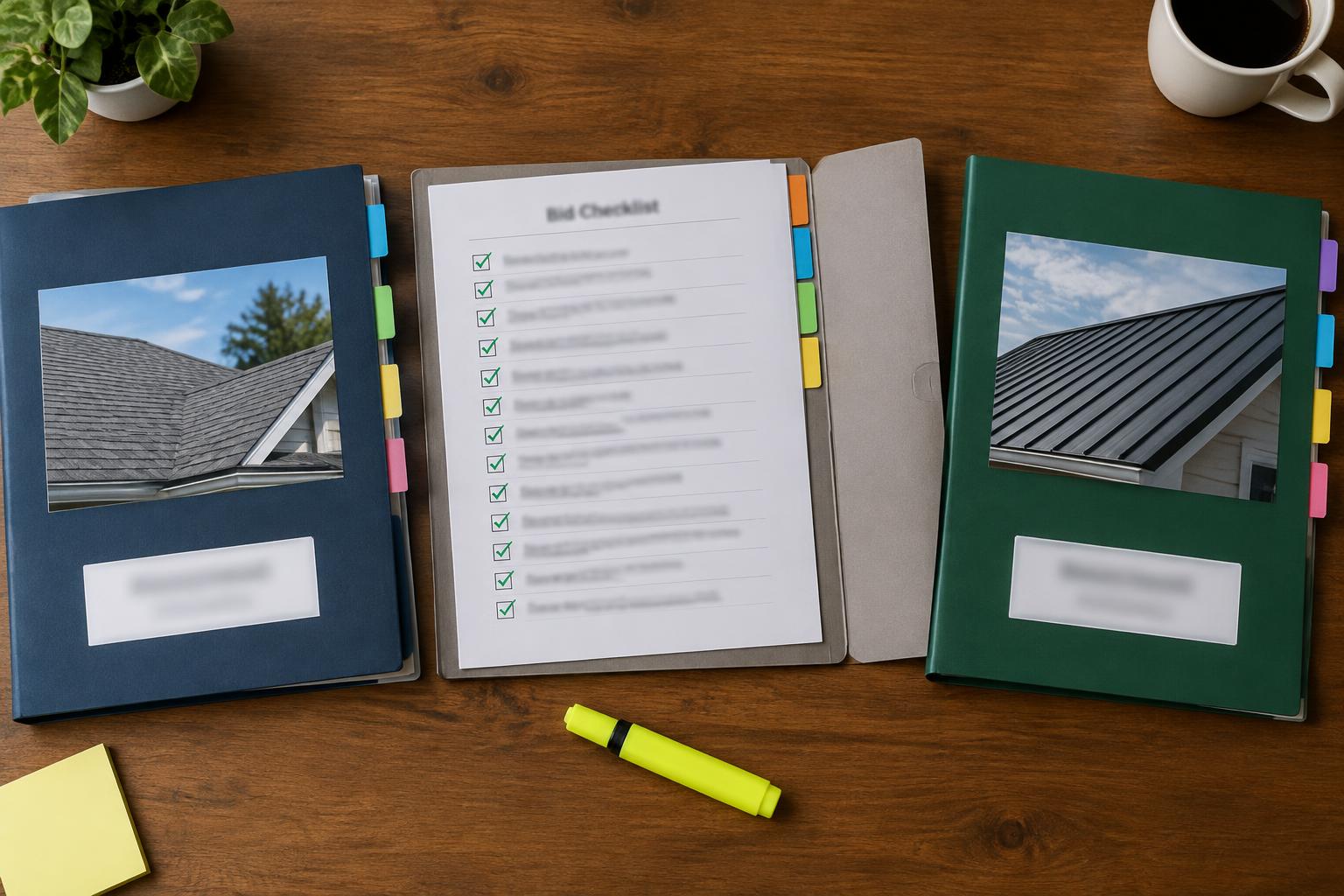
A roofing bid should tell you exactly what work you are buying. Use this checklist to make sure each bid names the products, the layers, the wood, the flashing, the cleanup, the warranty and how you will pay. If a line is missing, ask for it in writing before you sign.
Why a checklist helps
Roofing bids come in all shapes. One roofer hands you a single line that says new roof and a total. Another gives you three pages. It is hard to compare them as they are.
A checklist turns them into the same shape. You ask each roofer the same questions and fill in the same boxes. Then the real differences jump out.
We serve homeowners across the Omaha area, and this is the same checklist we would use for our own homes.
Check the company first
Before you read the price, read the top of the bid. It should list the full company name, a street address and a phone number. Look up the address. A real place is a good start.
In Nebraska, contractors must register with the state Department of Labor, and you can search its list online. In Omaha, residential roofing work also needs a city contractor license. In Iowa, contractors register with the state DIAL office. None of these prove good work, but they are basic steps a real business takes.
Ask for proof of insurance too. The FTC suggests checking licenses and asking for proof of insurance before you hire.
The scope of work
The scope is the list of jobs the roofer will do. It should be clear enough that a stranger could read it and know what you are getting.
A good scope names each step: removing old layers, checking and replacing bad wood, laying underlayment, installing flashing and drip edge, putting on shingles, installing ridge caps, changing vents if needed and cleaning up.
If a step is not listed, assume it is not included. Ask the roofer to add it or explain why it is not needed.
| Line item | A good bid says | Watch out if |
|---|---|---|
| Company details | Full name, address, phone and state registration | Only a cell number and first name |
| Scope | Every part of the work, in plain words | It just says new roof |
| Products | Brand and product line for shingles and underlayment | It says shingles with no name |
| Tear-off | Number of layers and that all will be removed | Layers are not mentioned |
| Decking | Price per sheet and photo proof before charging | No price for bad wood |
| Flashing and edges | New flashing, drip edge and pipe boots, or which are reused | Flashing is not listed |
| Attic air flow | What changes, if any, and why they fit your attic | Vents are added with no reason |
| Cleanup | Dumpster, nail sweep, gutter cleanout | Cleanup is not mentioned |
| Warranty | Maker and workmanship terms, both in writing | Only a spoken promise |
| Payment | Deposit, payment steps and final payment after the work | Full cash payment up front |
Products named by brand
Shingles, underlayment, ice and water layers and ridge caps all come in many brands and lines. A bid should name them.
Named products let you look up the maker's details and warranty. They also stop a silent swap to a cheaper line. If a roofer wants to change a product later, ask for it in writing.
Tear-off and wood
Ask the bid to say how many old layers are on the roof and that all will be removed. Extra layers add work and dumping cost.
Wood is the most common surprise. A strong bid lists a price per sheet for replacing bad deck boards. It also says the crew will show you photos of the bad wood before they charge for it.
Flashing, edges and pipe boots
Flashing is the metal at walls, chimneys and valleys. Drip edge runs along the roof edge. Pipe boots seal around plumbing vents. These are where many leaks start.
The bid should say which of these will be new and which, if any, will be reused. New pieces cost more now and can prevent leaks later.
Attic air flow, done for your attic
For a vented attic, roofers often adjust how air comes in low and leaves high. A bid might add or change roof vents.
Some homes are built with a sealed attic on purpose. Adding vents there can work against the design. A good bid explains what kind of attic you have and why any change fits it. If vents are added with no reason given, ask.
Cleanup and property care
Roofing makes a mess. Old shingles, nails and dust land around the house. The bid should say who brings the dumpster, how nails will be swept from the yard and drive, and whether gutters will be cleaned out.
Ask how they will protect plants, windows, a deck and your AC unit. Small things like this are easy to forget until the day of the job.
Warranty in writing
There are usually two kinds. The maker's warranty covers the products. The roofer's workmanship warranty covers how the roof was put on.
Both should be in writing, with how long they last and what can void them. Spoken promises are not enough. Ask who to call if something goes wrong and whether the warranty moves to a new owner if you sell.
Payment terms and red flags
The FTC advises not paying the full amount up front, and it notes some states limit down payments. The final payment should come after the job is done and you are satisfied.
The FTC also warns that scammers often show up after storms and may ask for cash, wire transfers, gift cards or payment apps. They may also claim they do not need a license. Walk away from any of those.
If you sign at your home, a federal rule may give you three business days to cancel. The contract should include a written notice about it.
Your final check before signing
Read through this short list one more time.
- Every box in the checklist chart has an answer.
- All promises are written in the contract.
- No blank spaces are left on the forms.
- You know the start window and how weather delays are handled.
- You know who to call during the job.
- You have a copy of everything you signed.
Schedule and weather
A bid should give a start window, not a firm promise. Roofing depends on weather. Rain, high wind and cold can all delay work.
Ask how long the job should take once it starts, what happens if rain comes mid-job and how the roof will be covered overnight. A crew should never leave the roof open to the weather.
Permits and city checks
Some jobs need a permit and a city check. Ask who will get the permit, whether its fee is in the price and whether a city inspection is part of the plan.
Rules depend on where you live. Omaha, the nearby Nebraska towns and Council Bluffs in Iowa each have their own offices. The roofer should know the rules for your address.
Who will be on your roof
Some roofers use their own crews. Others hire other companies, called subcontractors, to do the work. Both can be fine.
Ask who will do the work and who will be in charge on site. Ask if the crew is covered by insurance. You want one person you can call with questions during the job.
Insurance claim jobs
If your roof is part of an insurance claim, the bid still needs every line on this checklist. A claim does not change what a good roof needs.
Only your insurer decides what the claim pays. Be careful with anyone who asks you to sign over your claim rights before you understand them, or who offers to skip your deductible. Ask your insurer if you are unsure about any paper you are asked to sign.
A quick example of comparing bids
Say you have three bids. Bid A is the lowest. Bid B is in the middle. Bid C is the highest.
You fill in the checklist. Bid A does not list wood, flashing or cleanup. Bid B lists them all, with a price per sheet of wood. Bid C lists them all and adds a longer workmanship warranty.
Now the picture changes. Bid A may grow once the gaps are filled. Bid B and Bid C cover the same work, and the price gap is about the warranty. That is a choice you can make with clear eyes.
Questions to ask while you read a bid
Keep this short list nearby. Ask any roofer whose bid leaves you unsure.
- Can you walk me through each line?
- What is not included that I might expect?
- How do you handle bad wood you find?
- What happens if it rains during the job?
- Who do I call with a problem after the job?
- Can I see a sample of your warranty paper?
After you sign
Keep a copy of the signed contract and every page that came with it. Write down the name and phone of your contact.
Before work starts, move cars, take down wall hangings that could shake loose and tell your neighbors. After the job, walk the yard for nails and look at the roof from the ground. Check the ceilings after the first heavy rain.
Make the final payment only when the work is done and you are satisfied, as the FTC suggests. Ask for any final warranty papers at that time.
Red flags in the bid itself
Some warning signs show up on paper. Watch for a bid with no company address, a total with no line items, or blank spaces you are asked to fill in later. Be wary of pressure to sign today to keep a special price.
Also watch for a bid that names no products, skips flashing and wood, or offers a warranty only by word of mouth. Any one of these is a reason to ask more questions before you sign.
How our request form works
We serve homes and businesses across the Omaha area. This website is a preview right now. The online form checks your answers, but it does not save or send them yet, so no roofer gets your request from it.
When online requests are turned on, this note will change. Until then, the form is a way to see what we will ask: your town or ZIP, what you see and what kind of help you need. We do not sell your details.
Common questions
How many bids should I get?
Two or three is common. More than that can get confusing. What matters most is that each bid covers the same work, so you can compare fairly.
Is the lowest bid a bad sign?
Not always. But low bids often leave things out. Use the checklist to see what each bid includes. Then ask the low bidder about any gaps.
What if a roofer will not put something in writing?
Take that as a warning. A promise that is not written down is hard to hold anyone to. A good roofer is glad to write it out.
Can I cancel after I sign?
Under a federal rule, if you sign a deal at your home or away from the seller's regular place of business, you may have three business days to cancel. The contract should explain your right to cancel.
Should I sign a contract right after a storm?
Take your time. The FTC warns that scammers often show up after storms. Check the company, get it in writing and do not pay in cash or by gift card.
Related help
Sources we checked
Official and standards pages we used to check facts on this page. Rules can change, so confirm with the source.