Quick answer
TPO is a single-layer plastic roof sheet, most often white, used on many low-slope buildings. Its seams are joined with hot air, so the weld quality matters a lot. When you compare TPO bids, look at sheet thickness, how the sheet is held down, the insulation under it, the seam welds and the flashing at every edge and opening.
What TPO roofing is
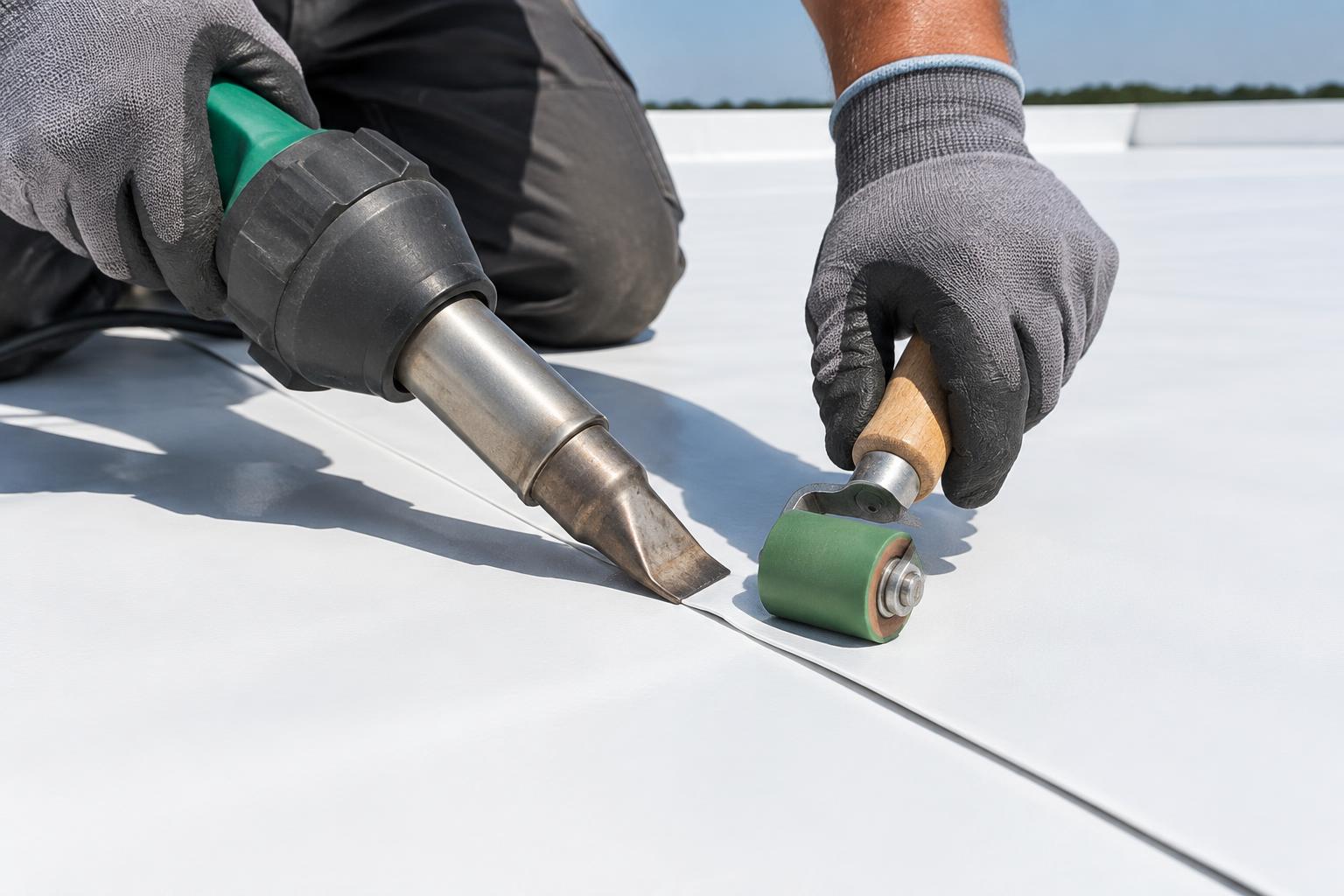
TPO is a roof sheet made from a plastic that softens with heat. It comes in wide rolls. Crews lay the rolls side by side, overlap the edges and weld them together with a hot-air tool. The result is one wide sheet over the roof.
There is a standard for TPO roof sheet, called ASTM D6878. It sets tests for things like thickness, strength and how the sheet holds up to heat. A bid that names the product lets you check that it meets the standard.
We serve building owners across the Omaha area and help them compare TPO bids in plain words.
Where TPO is a good fit
TPO is common on low-slope roofs of shops, offices, schools and warehouses. It is light, so it adds little weight. Its light color reflects sun, which can help keep the roof surface cooler in summer.
The U.S. Department of Energy notes that cool roofs are often cost-effective on low-slope commercial roofs. In places with cold winters, the savings in summer and the heat loss in winter both count. Ask the roofer to explain what that means for your building.
Why seams matter so much
The weld is the heart of a TPO roof. When hot air melts the two layers together, they become one. When the heat, speed or pressure is off, the weld can be weak even if it looks fine.
Good crews test welds. They may probe the seam edge with a small tool to find gaps. They may cut a small test sample at the start of the day to check their settings. Ask how they will check the seams on your roof.
Dirt, dew and old surface film can also hurt a weld. On repairs to older TPO, the roofer may need to clean and prepare the area first.
| Detail | What to look for | Question to ask |
|---|---|---|
| Sheet thickness | Written in mils on the bid | Why this thickness for my roof? |
| How it is held down | Fastened, glued or weighted | Which method, and why? |
| Insulation | Type, thickness and any tapered areas | Will you add slope where water sits? |
| Seam welds | Hot-air welded laps | How will you test the seams? |
| Flashing | Edges, walls, curbs, pipes and drains | Which details are made on site? |
| Warranty | Maker and installer terms, in writing | What upkeep does the warranty need? |
How the sheet is held down
There are three common ways. The sheet can be fastened with screws and plates along the seams, glued to the board below or held down with heavy stone or pavers.
Each method has trade-offs. Wind, the type of deck, the roof height and the edges all play a part. Your roofer should explain why they picked one method for your building, not just say it is their usual way.
The layers under the TPO
TPO sits on insulation board, and sometimes on a cover board too. The insulation keeps heat where you want it. The cover board gives the sheet a tough, flat base.
This is also where slope can be added. Tapered boards tilt toward drains and help stop water from sitting. If your old roof ponded, ask if the new one will have tapered areas.
If water got into the old insulation, a roofer may need to remove the wet boards. Laying new TPO over wet boards can trap the water.
Flashing: the edges and openings
Most leaks on a new TPO roof happen at details, not in the open field. Flashing is the extra sheet and metal used at walls, curbs, pipes, drains and edges.
Many makers sell pre-made corners and pipe boots. Some details are cut and welded on site. Both can work. What matters is a careful fit and a full weld all the way around.
Signs your TPO roof needs a look
You can watch for these from inside or from the ground. Do not go on the roof.
- New stains on ceiling tiles after rain
- Drips near air units, skylights or roof hatches
- Water that sits on the roof for days after a storm
- Loose metal at the roof edge, seen from the ground
- A storm with hail or high wind just passed
- Your last inspection was more than a year ago
Repair or replace a TPO roof
A tear, a punctured spot or a short open seam can often be patched. A patch works best when the sheet around it is still flexible and the boards below are dry.
Replacement makes more sense when problems show up all over, seams fail in many places or trapped water is wide. A moisture check and a full roof plan help you see the difference.
Coatings are a middle path for some roofs. They must be approved for TPO and need a sound, dry base.
Safety while the work is done
A TPO job means crews near open edges with hot tools. Federal rules require fall protection for roofing on low-slope roofs with edges six feet or more above a lower level. Ask the crew to show you their plan for your roof, including how they will guard edges and skylights.
Ask how they will keep people inside safe too. Hot tools, glue smells and noise can affect staff and tenants. A good plan covers work hours, fresh air and safe paths below.
Questions to ask a TPO contractor
Write the answers down for each bid.
- What product and thickness will you use?
- How will the sheet be held down, and why?
- What insulation and cover board are included?
- Will you remove wet boards, and how will you find them?
- How will you test the seam welds?
- What warranty comes with the job, and from whom?
TPO next to EPDM and PVC
These three sheets are the most common single-layer roofs on flat buildings. They look alike from far away, but they work in different ways.
TPO and PVC are both plastics with seams that are welded with hot air. EPDM is rubber, and its seams use tape or glue. PVC is often picked for roofs that see grease from kitchen fans or some chemicals. EPDM has a long track record on many older buildings. TPO is widely used on new low-slope roofs.
No one sheet wins every time. Ask each roofer which one they suggest and why. Also ask which one their crew installs most often. A crew that knows a system well often does cleaner work with it.
Hail, wind and TPO
Large hail can bruise or puncture a roof sheet, especially where the board below is soft. Wind can pull at edges and corners, where the force on a roof is strongest.
After a big storm, have a crew check the roof. They look for punctures, cracked flashing, loose edge metal and seams that opened. Damage on a flat roof can be hard to see, so ask for close photos with the spot marked on a plan.
If you plan to file a claim, keep the storm date and your photos. Only your insurer decides what is covered.
Putting TPO over an old roof
Sometimes a new TPO sheet can go over the old roof instead of tearing it all off. This is called a recover. It can save time and waste.
A recover only works when the old roof is dry and sound. If water is trapped under the old roof, covering it can seal the water in. Building codes also limit how many roof layers a building can have. A moisture check and a talk with the local permit office help decide if a recover is allowed and wise.
Upkeep for a TPO roof
A TPO roof still needs care. Keep drains clear, check seams and flashing each spring and fall, and look after storms. Clean off debris that holds water.
Many warranties ask the owner to keep records of upkeep. Keep the bills and photos in one place. If a claim comes up, those records help.
What a TPO repair visit looks like
For a small repair, the crew first finds the source. They check seams near the leak, the flashing at nearby units and any pipes or drains in that area.
Next they clean the spot. Older TPO can have a dull, dirty film on top. The crew scrubs it and may use a cleaner made for TPO, so the patch can bond.
Then they weld a patch over the problem with hot air and roll it down. A careful crew probes the edge of the new weld before they leave.
Ask for photos of the before and after, and ask how long the patch should last on a sheet of this age.
Reading a TPO warranty
There are often two warranties. The maker covers the product, sometimes with rules about who installs it and how. The roofer covers their own work for a set time.
Read the list of what can void each one. Common items are missing upkeep records, other trades cutting into the roof without the roofer, and damage from storms or traffic. Some warranties only cover the sheet, while others cover more of the system.
Ask for both warranties in writing before the job, not after. If a roofer says a long warranty is included, ask to see a sample of the actual paper.
Planning around your business
A TPO job happens over your head while your business keeps going. Ask the roofer how they will stage materials, where the crane or lift will park and which doors staff and customers should use.
Hot-air welders are quieter than torches, but there is still noise, foot traffic and some smell from glue on certain details. Ask about work hours, how they will protect air intakes and how they will close the roof each night so rain cannot get in.
A written plan for these items makes the job smoother for tenants and staff.
How our request form works
We serve homes and businesses across the Omaha area. This website is a preview right now. The online form checks your answers, but it does not save or send them yet, so no roofer gets your request from it.
When online requests are turned on, this note will change. Until then, the form is a way to see what we will ask: your town or ZIP, what you see and what kind of help you need. We do not sell your details.
Common questions
What does TPO stand for?
Thermoplastic polyolefin. In plain words, it is a plastic that softens with heat. That is why its seams can be welded with hot air.
Is TPO always white?
White is the most common. Some makers offer gray and tan. Lighter colors reflect more sun, which keeps the roof surface cooler on hot days.
Can TPO be repaired?
Yes, small tears and seam gaps can often be patched. Older sheets may need to be cleaned and prepared with care before a patch will hold. Ask the roofer how they will prepare the surface.
Can TPO go over my old roof?
Sometimes. It depends on the old roof's condition, how many layers are there, whether water is trapped and local rules. A moisture check helps decide.
Is TPO the same as PVC?
No. Both are plastic sheets with welded seams, but they are made of different materials. PVC is often picked for roofs with grease or some chemicals. Ask which fits your building.
Related help
Sources we checked
Official and standards pages we used to check facts on this page. Rules can change, so confirm with the source.