Quick answer
If you borrow for a roof, compare like loan types: amount, APR, fees, term, total paid, rate type, payment dates and home security. A HELOC's APR leaves out fees, so it is not a fair match for a closed-end loan's APR. Compare fees on their own too. Installment loans, cards and home equity debt work in different ways. Deferred-interest deals may charge interest back to the purchase date. Home equity debt puts your home at risk. This is education only. We don't offer loans, name lenders, quote rates or ask for money details in our form.
Start with the roof, then the loan
Before you look at loans, get clear on the roof job. A loan for the wrong scope is a costly mistake. Get a written, itemized bid. Know what is a repair and what is a full replacement.
Our repair-or-replace guide and bid checklist can help. Once you know the price and the scope, you know how much you might need to borrow, if any.
Some people pay cash. Some use savings plus a small loan. Some borrow the full amount. There is no single right answer. It depends on your budget and your comfort with debt.
This page is education only
We are a roofing help site. We don't lend money. We don't work with a set lender. We don't check credit or approve anyone.
We don't quote rates, credit scores or monthly payments. Those depend on the lender, your history and the market. We also don't give tax or legal advice.
What we can do is explain the basic loan types in plain words. The facts here come from the Consumer Financial Protection Bureau, a federal agency that helps people understand money products.
Personal installment loans
An installment loan gives you a set amount up front and a fixed number of payments. With a fixed-rate, fixed-payment installment loan, the scheduled payment stays the same. Check the terms.
Many personal loans are unsecured. That means no house or car is pledged. Rates and fees vary a lot. Some loans have an origination fee taken out at the start.
Ask for the APR, the total of payments and any fees. Ask if there is a charge to pay it off early. Compare at least two offers if you can.
| Check | What to look for | Why it matters |
|---|---|---|
| Amount financed | The sum you actually borrow | Fees can be added on top |
| APR | Compare like loan types | HELOC APR leaves out fees; closed-end APR includes some |
| Fees | Origination, late, early payoff | They raise the real cost |
| Term | How many months | Longer can mean lower payments but more total cost |
| Total of payments | Everything you will pay back | The clearest single number |
| Rate and payment | Check both, not just the rate | A fixed rate alone does not fix a card or HELOC payment |
| Collateral | Is your home pledged? | Missed payments can risk the home |
Credit cards and store cards
A credit card is revolving credit. You can borrow up to a limit, pay some back and borrow again. Payments change with your balance.
Card rates are often higher than other loans. If you only pay the minimum, a large roof bill can take a long time to pay off and cost much more than the price.
Some cards offer a low intro rate for a time. Know when that ends and what the rate becomes after.
Watch out for deferred interest
Some deals say "no interest if paid in full in 12 months." That sounds like zero percent. It may not be.
The CFPB explains how deferred interest works. Interest builds up in the background. If you pay the whole balance on time, you don't pay it. If you miss the deadline, even by a small amount, the interest can be charged back to the day of the purchase.
That can be a big surprise. If you use one of these deals, plan to pay it off early. Know the exact end date and the exact amount. Read how payments are applied.
Home equity loans and lines of credit
Home equity debt uses the value of your home as security. A home equity loan pays a lump sum. A home equity line of credit, or HELOC, lets you draw money as needed, up to a limit.
A HELOC often has a variable rate. Its payment also depends on how much you owe and its phase: a draw period, then a payback period. Payments can rise when that phase changes, even if the rate does not.
The big point: your home secures the debt. If you can't pay, you could lose the home. There may also be closing costs and fees. Take your time and read every term.
Read the APR, not just the rate
APR means annual percentage rate. For a closed-end loan, it includes the rate and some loan fees. A HELOC's APR is based on interest alone and excludes fees. Those two APRs are not a direct match.
Compare like products: a closed-end loan with another closed-end loan, or one HELOC with another. Compare fees on their own as well. Ask what each APR includes.
APR is not the whole cost. Rates can change. A longer term can cost more. For a HELOC, check draw and payback terms, fees and the balance you plan to use.
Total of payments tells the full story
Ask each lender for the total of payments. That is every dollar you will pay back over the life of the loan, if you pay as planned.
Lower monthly payments often come from a longer term. That can feel easier, but you may pay more in the end. Look at both the monthly payment and the total.
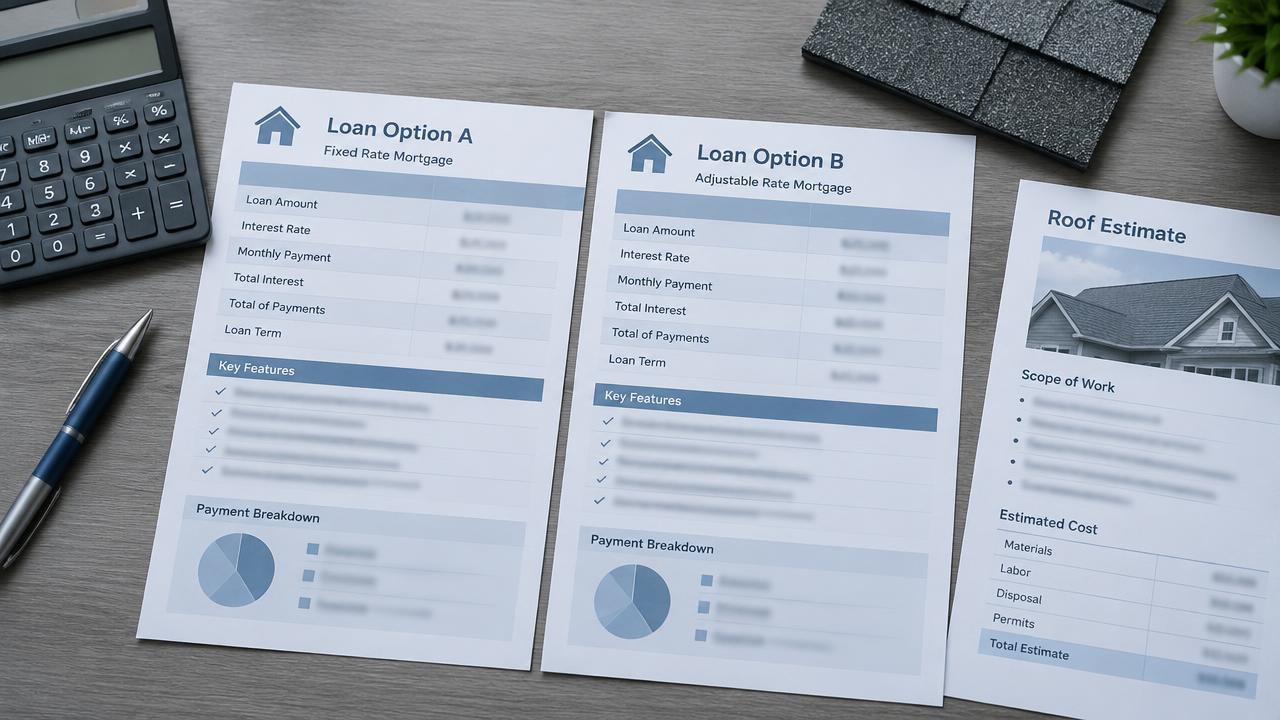
Write the numbers for each offer in a simple table. Seeing them side by side makes the choice clearer.
Fixed or variable
A fixed rate stays the same. Only a fixed-rate, fixed-payment installment loan has a set scheduled payment. A card or HELOC payment can change with your balance or loan phase even at a fixed rate.
A variable rate can go up or down with the market. Your payment can change. Ask how often it can change, how high it can go and what would make it rise.
Ask whether both the rate and payment are fixed. Plan for balance changes, fees and any shift from drawing money to paying it back.
Timing and roof work
Ask when the money arrives and when payments start. Some loans pay you. Some pay the contractor. Some pay in stages.
Don't pay the full roof price before work starts. A fair payment plan ties payments to progress. Our bid checklist covers this.
Get the roof contract and the loan papers as separate documents. Read both. Know who you owe and what happens if the job changes.
Red flags with loan offers
Be careful with pressure to sign the same day. Be careful if someone fills in loan forms for you or won't give you copies.
Be wary of any offer tied to a door-to-door sale right after a storm. Take time. Read the terms at home. You can ask a trusted friend, family member or advisor to look too.
Never give bank, card or Social Security numbers to someone you didn't seek out. Use the lender's own secure site or office.
Simple steps to compare offers
First, know the roof bid amount. Second, get offers in writing. Third, compare the same loan types. List APR, separate fees, term, total paid, rate type and home security.
Fourth, ask questions about anything unclear. Fifth, read the final papers before you sign. If the final terms differ from the offer, ask why.
It is fine to walk away from an offer that doesn't feel right.
Who to talk to
Your own bank or credit union is a good place to start. They already know you. You can also ask more than one lender and compare.
A trusted friend or a money advisor can read the offer with you. Two sets of eyes catch more.
If a lender or seller pushes you to rush, slow down. Ask how long the offer lasts. Don't assume it will still be there tomorrow.
Know your own budget first
Before you look at offers, look at your own monthly budget. How much can you pay each month without strain? Leave room for surprises.
A payment that fits today may not fit if your rate changes or your costs go up. Plan with some cushion.
Questions to ask any lender
What does this APR include? What fees do I pay, and when? Is this the same loan type as the other offer? What total will I pay back?
Is the rate fixed or can it change? Is my home or anything else pledged? Is there a fee to pay it off early? What happens if I pay late?
Ask for the answers in writing. A good lender will be glad to explain.
Saving up or doing it in steps
Not every roof job has to happen today. If the roof is not leaking, you may have time to save. A roof check can tell you how urgent the work is.
Some jobs can be split. A small repair now can buy time for a full roof later. Ask the roofer what is safe to wait on and what is not.
Don't delay a repair that stops active leaks. Water damage grows fast and can cost more than the loan you hoped to avoid.
Keep the papers together
Save the loan papers next to the roof bid and contract. Note the due date for each payment. Set a reminder a few days early.
If you used a deferred-interest deal, write the end date in large print. Plan to pay the last dollar well before it.
How we serve owners planning a roof
We are serving homeowners and building owners across the Omaha area who need a repair or a new roof. Use the form on this page to ask for a roof check or bid. Share roof details only.
A clear written bid gives you a firm number to take to any lender you choose. We don't offer loans, and we never ask for financial details in our form.
Common questions
Do you offer roof financing?
No. We don't offer loans, work with a set lender or check credit. This page explains how common loan types work so you can compare offers from lenders you choose.
What is deferred interest?
Some cards and store plans say "no interest if paid in full" in a set time. The CFPB explains that if you don't pay the full amount by the end, interest can be charged back to the purchase date. Read the terms before you sign.
Is a home equity loan a good idea for a roof?
It can have a lower rate, but your home secures it. If you can't pay, you could lose the home. Talk with the lender and a trusted advisor, and compare the full cost.
Will a roof loan help my taxes?
We don't give tax advice. Ask a tax professional about your own case.
Should I put my bank details in your form?
No. Our roofing form is for roof questions only. Never share bank, card or Social Security numbers in it.
Related help
Sources we checked
Official and standards pages we used to check facts on this page. Rules can change, so confirm with the source.