Quick answer
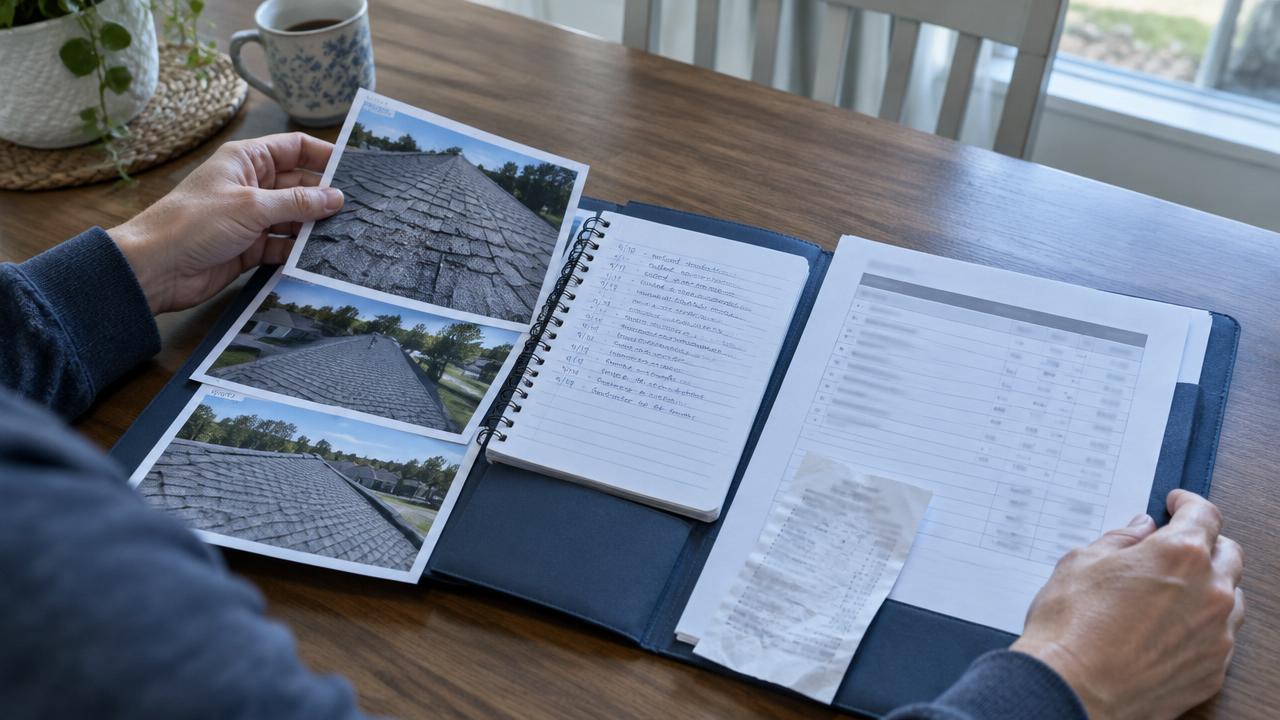
After roof damage, keep a dated record: when it happened, safe photos, what you saw versus what you think caused it, old roof papers, inspection notes, itemized estimates, receipts for urgent fixes and notes on every call. Contact your insurer promptly and give them a chance to inspect before permanent repairs. Never delay safety or urgent steps to stop more damage. Your policy, its endorsements and your insurer decide coverage. We don't promise a free roof, a payout or a waived deductible, and we don't negotiate claims.
Why records matter after roof damage
A storm, a fallen limb or a slow leak can leave you with many questions. When did it start? What broke? What did it cost to fix? Good records answer those questions without guessing.
Clear notes also help the people you work with. Your insurer, an adjuster and a roofer can all read the same facts. That saves time and cuts down on mix-ups.
This page is about keeping good records. It is not legal advice. It is not a promise of coverage. Your policy and your insurer decide what is paid.
Safety comes before photos
Don't climb onto the roof to take pictures. Wet, steep or damaged roofs are very easy to fall from. A ladder in wind is not safe either.
Stay out of rooms with a sagging ceiling. If water is near outlets, lights or the electric panel, stay away from it. Call the power company or an electrician from a safe place. If a roof looks like it may give way, leave the building and call 911.
Take photos from the ground, a window or the yard. A phone zoom can show a lot. A trained roofer with the right gear can get close-up shots later.
Start a timeline the same day
Get a notebook or a phone note. Write the date and time of the storm or the first time you saw water. Write what the weather was like, if you know.
Then add each step as it happens. When did you call your insurer? Who did you speak with? When did a roofer come out? When was the tarp put on?
Short notes are fine. "Oct 3, 4 p.m. Water dripping in back bedroom. Put a bucket down." A list like that is easy to read months later.
| Record | What it shows | Tip |
|---|---|---|
| Timeline | When things happened and who you talked to | Write it the same day, then add to it |
| Safe photos | What you can see now | Shoot from the ground or a window, never from the roof |
| Seen vs. suspected | Facts kept apart from guesses | Use two columns: 'I saw' and 'I think' |
| Old roof papers | How the roof looked before | Invoice, past inspection, earlier photos |
| Inspection report | What a trained person found | Ask for photos tied to each finding |
| Itemized estimate | The work, part by part | Line items, not one lump number |
| Urgent-fix receipts | What you spent to stop more harm | Keep the receipt and a photo of the fix |
Taking clear, safe photos
Start wide, then get closer. A wide shot of each side of the house shows where things are. A closer shot shows the detail.
Inside, photograph stains, drips and wet spots. Put a ruler or a coin near a stain so the size is clear. Take the same shot again a day or two later to show if it grew.
Outside, look for shingles on the ground, bent gutters, dented vents or downspouts, and broken limbs. Take photos of things in the yard, too. Don't move debris before you shoot it, unless it is a safety risk.
Keep the original files. Don't crop or filter them. Most phones save the date and time with each photo, and that helps.
Keep what you saw apart from what you think
This is one of the most useful habits. Make two lists. One says what you saw. The other says what you think caused it.
"I saw three shingles in the yard" is a fact. "Hail broke my roof" is a guess until someone checks. Leaks can come from wind, hail, old flashing, ice dams or a cracked pipe boot. Some damage is old wear, not storm damage.
Keeping the lists apart makes your notes more honest. It also helps the person who inspects the roof. They can test each guess instead of starting from a story.
Find the roof's past records
The condition of the roof before the storm matters. Look for the invoice from when the roof went on. Look for any old inspection report or repair receipt.
Old photos help too. Real estate photos, a drone shot from a sale, or even family photos can show how the roof looked. Save them with your other notes.
If you bought the home recently, your home inspection report may describe the roof. Add it to the folder.
Tell your insurer promptly
Nebraska's insurance department tells people to contact their insurer or agent soon after damage. Your policy will say how and when to give notice. Read it, or ask your agent.
When you call, have your policy number and your timeline. Write down the claim number, the person's name and what they told you. Ask what they need from you and how they want it sent.
Ask if they want to inspect before permanent repairs. Giving them a chance to see the damage is a key step. It does not mean you leave a hole open in the rain.
Stopping more damage while you wait
Many policies expect you to take reasonable steps to keep damage from getting worse. That might mean a tarp over a hole, a bucket under a drip or moving things out of a wet room.
A tarp on a roof is a job for a trained crew with fall protection. Don't do it yourself. Indoors, you can move furniture and catch water if it is safe.
Keep every receipt. Take photos before and after the urgent fix. Write down who did it and when. These are often called temporary repairs or mitigation. Save them as their own group in your folder.
What a roof inspection adds
A roofer with the right gear can look closely at shingles, flashing, vents and the edges. They can note what looks new and what looks old.
Ask for a written report with photos. Each finding should point to a photo. "Lifted shingles on the north slope, see photos 4 to 7" is far better than "storm damage."
A good report says what was found and how sure the inspector is. It should not promise what an insurer will decide. That is not the roofer's call.
Itemized estimates are easier to compare
An estimate with one big number is hard to check. Ask for one with line items. It might list tear-off, underlayment, shingles, flashing, vents, gutters, disposal and any wood repair.
Each line should show what part of the roof it covers. If something is unknown, like how much wood is bad under the shingles, the estimate should say how that will be handled.
Your insurer may write its own estimate. If the two don't match, compare them line by line. Ask your insurer about any gap. Don't ask a roofer to bend the numbers to match.
Keep notes on every conversation
After each call or visit, jot down the date, who you spoke with and what was said. If someone promises to send something, note what and when.
Email can help. A short note after a call, like "Thanks for talking today. You said the adjuster will call by Friday," makes a clear record.
Save letters, emails and texts in the same folder. A single place for everything makes it easy to answer questions later.
Learn a few policy words
Nebraska's insurance department has a list of common homeowner terms. A few come up a lot with roofs.
The deductible is the part you pay before the policy pays. Some policies have a separate deductible for wind or hail. Replacement cost and actual cash value are two ways to figure what a policy pays. An endorsement is an add-on that changes the policy.
Read your declarations page. It lists your coverages and deductibles. Ask your agent to explain anything that is not clear.
Watch for red flags
Be careful with anyone who knocks on the door right after a storm and pushes you to sign fast. Ask for a written estimate and time to think.
Be wary of offers to cover your deductible or to "get you a free roof." Be careful about signing anything that hands your claim rights to someone else before you read it closely.
Nebraska's guide suggests getting more than one estimate and checking a contractor before you hire. Ask for proof of insurance and a written contract.
A simple folder system
Make one folder, on paper or on your phone. Inside, make small groups: timeline, photos, old roof papers, reports, estimates, receipts and talks.
Name photo files with the date and the spot, like "Oct 3 back bedroom ceiling." Back up the folder to a second place in case a phone breaks.
When someone asks for a paper, you can find it fast. That keeps things calm on a hard week.
How we serve owners with storm damage
We are serving homeowners and building owners across the Omaha area after storms and leaks. Use the form on this page to ask for a roof check. Tell us when you first saw damage and what you saw.
We can inspect the roof, take photos and write an itemized scope. We don't negotiate with insurers, promise a payout or waive deductibles. Your insurer decides coverage. We help you see what is on the roof.
Common questions
Should I wait for the insurer before stopping a leak?
No. Safety comes first, and most policies expect you to take reasonable steps to stop more damage. Keep receipts and photos of what you did. Wait on permanent repairs until your insurer has had a chance to look, unless they tell you otherwise.
Will insurance pay for my new roof?
We can't say. Your policy, its endorsements and your insurer decide that. Some policies pay the cost to replace. Others pay a lower amount based on age and wear. Read your declarations page and ask your agent.
Can a roofer cover my deductible?
We don't waive, rebate or hide deductibles. The deductible is part of your deal with your insurer. Ask your insurer or agent if you have questions about it.
Do you handle the claim for me?
No. We don't negotiate claims or act for you with your insurer. We can look at the roof and write down what we find, with photos and an itemized scope, so you have clear facts to share.
Is there a deadline to file?
Your policy sets its own notice and filing terms. We don't list a deadline here. Read your policy and ask your insurer or agent soon after the damage.
Related help
Sources we checked
Official and standards pages we used to check facts on this page. Rules can change, so confirm with the source.