Quick answer
Metal roofing for homes comes in two main kinds. Standing seam panels lock together at raised seams and hide their fasteners. Exposed-fastener panels are screwed down through the face of the metal. They differ in price, upkeep and how they handle heat movement. We help Omaha-area owners compare a full installed system, not just a stack of panels.
Two kinds of metal roofs
When people say metal roof, they may mean two very different things. Knowing which one a bid means is the first step.
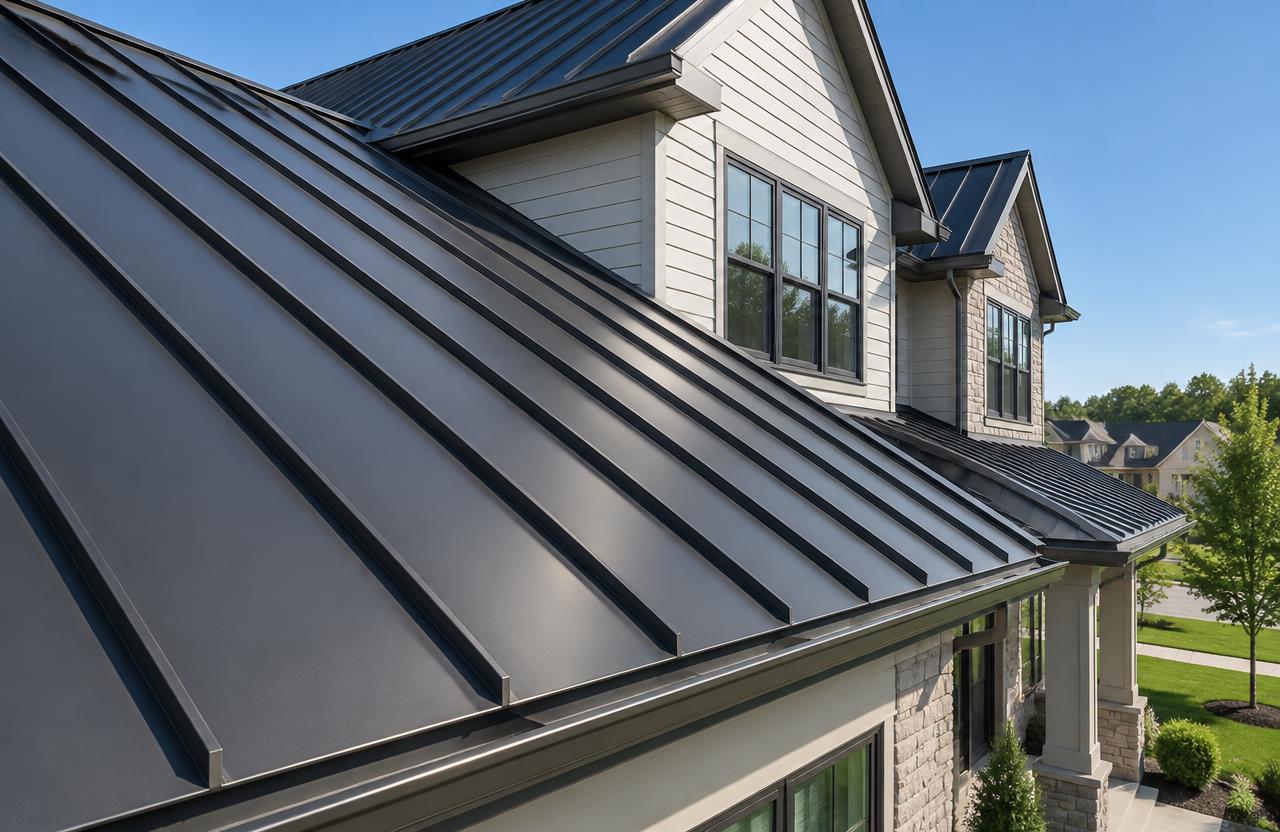
A standing seam roof uses long panels that run from the top of the roof to the edge. Each panel has raised sides. The sides lock or snap together into a seam that stands up an inch or two. Clips under the seams hold the panels to the deck. You do not see screws on the face of the roof.
An exposed-fastener roof uses panels with ridges pressed into them. The crew lays each panel over the next one and drives screws straight through the metal. Each screw has a rubber washer that seals the hole. You can see rows of screw heads across the roof.
Both can keep water out. They just do it in different ways, and they ask for different care over the years.
Why the fasteners matter so much
Metal grows a little when it is hot and shrinks when it is cold. On a sunny day after a cold night, a roof panel can move.
Many standing seam roofs use hidden clips. Some clips let the panel slide. Others hold it fixed, which can be fine on short panels. The Metal Construction Association says the right clip depends on the panel system and the building, and long panels often need sliding clips. Ask which clip the maker calls for on your roof.
With exposed fasteners, the panel pulls back and forth on the screws. Over many seasons, a screw hole can get wider and a washer can dry out and crack. Then water can find the hole. That is not a flaw. It is a known part of this system, and good owners plan for screw checks.
So the question is not which one is better. The question is which one fits your home, your budget and how much upkeep you want.
Picking the right one for your home
Use these simple pointers as a starting place. A crew who sees your roof can tell you more.
- You want a clean look and fewer things to check later: standing seam is often the better fit.
- You are covering a garage, shop or barn and want to keep the price down: exposed fastener is common.
- Your roof is fairly low in slope: check the maker's lowest allowed slope for each panel.
- You have many skylights, chimneys or vents: ask how each kind handles openings on your roof.
- You plan to add solar later: ask how mounts attach to each kind without drilling extra holes.
| Question | Standing seam | Exposed fastener |
|---|---|---|
| How is it held down? | Often hidden clips under raised seams | Screws through the flat face of the panel |
| Parts to inspect | Sealants at trim, openings and seams | Rubber washers on the many screws |
| Upkeep to plan for | Checks at trim, vents and seams | Screw checks and re-tightening or swaps over time |
| How it handles heat swings | Depends on the clip type the maker specifies | Panels pull on screws as they grow and shrink |
| Common uses | Homes, porches, low slopes the maker allows | Barns, sheds, shops and some homes |
| Upfront price | Usually higher | Usually lower |
What a full system includes
A metal roof is more than panels. A full system has underlayment under the panels, trim at every edge and flashing at walls, chimneys and vents. The trim and flashing are where many leaks start.
Some owners buy panels from a supplier and hire a crew to put them on. That can work, but it splits the job. If a leak shows up, the supplier may blame the crew and the crew may blame the panels. A single written scope from one installer is easier to hold someone to.
Ask the roofer to list each part in the bid. Look for underlayment type, trim pieces, closures, sealants, snow guards if needed and how ridge venting will work if your attic is vented.
Snow, ice and sliding
Snow can slide off metal in a big sheet. That can damage gutters, plants or whatever is below. Over doors and walkways, it can hurt people.
Snow guards are small blocks or bars that hold snow so it melts off slowly. Ask whether your roof needs them and where. The panel maker often has a layout guide.
Ice dams can still form on a metal roof when warm air from the house melts snow higher up. The fix for that is often in the attic, not on the roof. Our ice dam page explains more.
Color, coating and heat
Most home metal roofs have a factory paint finish. The paint protects the metal and gives it color. Different paints fade and chalk at different rates. The warranty for the paint is often separate from the warranty for the metal.
Light colors reflect more sunlight. The Department of Energy's cool roof guide explains that a reflective roof can lower the roof's surface heat in summer. How much that helps inside depends on your attic and insulation.
Ask for paint samples in daylight. Colors look different on a small chip than on a whole roof.
Repairing an existing metal roof
Not every metal roof problem needs a new roof. Many leaks come from a few places.
- Loose or backed-out screws on an exposed-fastener roof.
- Cracked rubber washers that no longer seal.
- Failed sealant at trim, ridge caps or pipe boots.
- A dent or hole from a falling branch.
- Rust where paint wore away or where water sits.
When repair stops making sense
If rust has eaten through many panels, or the roof leaks in many places, spot fixes add up. A crew may suggest a coating system for some metal roofs, or full panel replacement. Our roof restoration page explains when a coating may fit and when it does not.
Ask for photos of each problem area. Ask how many screws or seams were checked. A good report tells you what was not checked, too.
Permits and paperwork in the Omaha area
Many towns require a permit for a new roof. The City of Omaha has a permits and inspections office with answers to common questions. Nearby towns and Council Bluffs, Iowa, each have their own rules. Ask the roofer who will pull the permit and check the address with the local office.
In Nebraska, contractors working on other people's property must register with the state Department of Labor. The state says registration is not a mark of quality. Use it as one step, along with insurance proof and past work.
Reading a metal roofing bid
Compare bids line by line. Two bids that both say metal roof can describe very different jobs.
- Panel type: standing seam or exposed fastener, with the profile name.
- Metal and thickness: steel or aluminum, and the gauge.
- Paint system and its written warranty terms.
- Tear-off or overlay, and what happens if bad deck is found.
- Underlayment, trim, closures and snow guards.
- Workmanship warranty and what it covers.
Avoiding pushy sales
The FTC warns about home repair sellers who show up at the door, push you to decide fast or ask for full payment up front. Get the plan in writing. Take time to compare. A fair crew will give you room to decide.
We serve homes across the Omaha area. When you are ready, tell us about your roof and what you want from a metal system.
Living with a metal roof
Once a metal roof is on, upkeep is simple but real. Look at it from the ground after big storms. Keep gutters clear so water does not back up under trim. Trim branches that rub the panels, because rubbing wears through paint.
On an exposed-fastener roof, plan for a crew to check screws every few years. On standing seam, ask them to look at sealant at trim and boots. Small fixes done early keep a long-lasting roof working.
Steel or aluminum
Most home metal roofs are steel with a metal coating, like zinc, under the paint. The coating helps stop rust if the paint gets scratched. Aluminum does not rust the way steel does, and it is lighter. It often costs more and can dent more easily.
Panel thickness is listed as a gauge. A smaller gauge number means thicker metal. Thicker panels resist dents and bending better, but they cost more. Ask what gauge the bid uses and why it fits your roof.
Openings are where the care goes
Every pipe, vent, skylight and chimney cuts through the panels. Each one needs a boot or flashing made for metal. A rubber pipe boot can dry out in the sun over the years, just like on a shingle roof.
On standing seam, a crew tries to place openings so they do not land on a seam. On exposed fastener, they plan the screws and sealant around each boot. Ask how they will handle each opening on your roof. A sketch or photo plan is a good sign.
Hail and dents
Hail can dent metal. A dent may only change how the roof looks, or it may crack the paint and let rust start. Some panels carry an impact rating from testing. Read what the rating means and whether your insurer gives any credit for it. Do not assume a rating means the roof cannot dent.
How our request form works
We serve homes and businesses across the Omaha area. This website is a preview right now. The online form checks your answers, but it does not save or send them yet, so no roofer gets your request from it.
When online requests are turned on, this note will change. Until then, the form is a way to see what we will ask: your town or ZIP, what you see and what kind of help you need. We do not sell your details.
Common questions
Is a metal roof loud in the rain?
Most homes have solid wood decking, a layer of underlayment and attic insulation under the metal. Those layers soften the sound a lot. A shed with bare metal over open framing is much louder. Ask the roofer what will go under your panels.
Can metal go right over my old shingles?
Sometimes. It depends on the maker's rules, how many layers are already there, the deck's condition and local permit rules. A crew should check for soft or rotted deck first. Covering a wet or weak deck hides a problem.
Will a metal roof make my house hotter or colder?
Metal itself does not insulate much. Comfort depends on your attic insulation and air sealing. A light, reflective color can help in summer, and the Department of Energy explains that cool roofs reflect more sun.
Does metal attract lightning?
Metal does not make a strike more likely. If lightning hits, metal spreads the charge and does not burn. Ask an electrician about lightning protection if that is a worry for your area.
How long will it last?
That depends on the metal, its coating, how it was put on and your weather. Read the written paint and panel warranty. A long number on a brochure is not a promise for your house.
Related help
Sources we checked
Official and standards pages we used to check facts on this page. Rules can change, so confirm with the source.