Quick answer
Commercial roof repair fixes one problem area on a low-slope roof, like a split seam, a leaking curb or a clogged drain. It makes sense when the rest of the roof is sound and mostly dry. A moisture check, clear photos and a written scope help you avoid paying to patch a roof that needs more.
The short answer
A commercial roof repair fixes one part of a business roof. It might be a seam, a puncture, flashing at an air unit or a clogged drain.
Repairs are a smart use of money when the roof is still in good shape overall. But on a flat roof, the visible leak is often only part of the story. Wet insulation and drainage problems can hide under a roof that looks fine. This page helps you get a repair that actually fixes the problem.
Who this helps
This page is for owners and managers of shops, offices, warehouses, churches, restaurants, schools and apartment buildings. If you are in charge of a roof, you are in the right place.
Common commercial repairs
Most commercial repairs fall into a few groups.
- Seams: the joints between membrane sheets can open up over time.
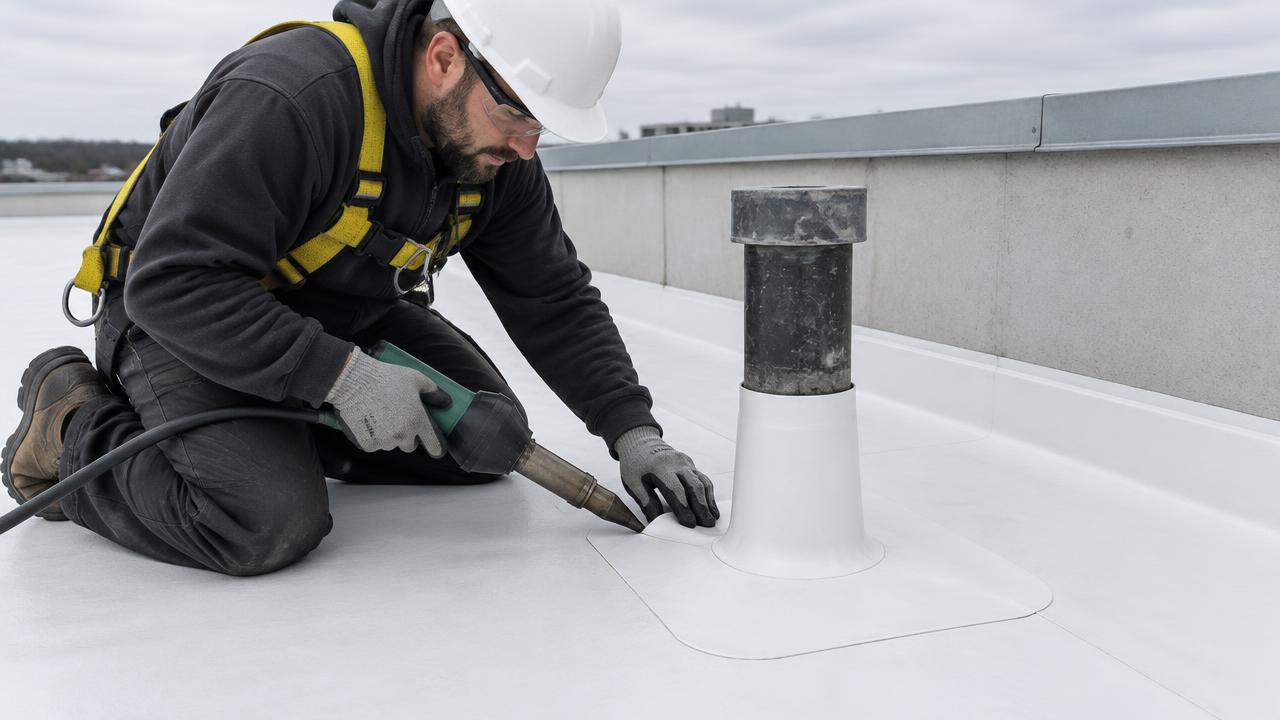
- Penetrations: pipes, vents and supports that go through the roof need flashing that can fail.
- Curbs: the raised frames under air units are a common leak spot.
- Drains and scuppers: clogs cause ponding and leaks at the drain.
- Edges and parapets: metal trim and wall flashing can loosen in wind.
- Punctures: dropped tools, foot traffic or hail can poke holes.
| Problem | Typical repair | Check first |
|---|---|---|
| Split or open seam | Clean and re-weld or re-tape the seam | Is the membrane still flexible? |
| Leak at an air unit curb | New flashing at the curb | Was other trade work done there? |
| Clogged drain | Clear drain and strainer | Is ponding wearing the area? |
| Puncture | Membrane patch | Did water reach the insulation? |
| Loose edge metal | Re-secure and seal the edge | Any wind lift nearby? |
| Blisters or bubbles | Cut, dry and patch | Are there many across the roof? |
Why flat roof leaks are hard to find
On a low-slope roof, water does not always drip below the hole. It can run under the membrane, soak into insulation and travel a long way.
That is why a leak above aisle five may start near a drain on the other side of the building. Patching the spot above the drip often fails.
Roofers use several tools to find leaks. They may walk the roof and test seams with a probe. They may use an infrared camera at night to see wet areas that hold heat. They may cut small cores to check the insulation.
Check for wet insulation first
Most flat roofs have foam insulation boards under the membrane. When water gets in, the boards soak it up.
Wet insulation does not insulate well. It adds weight and can rust metal decks or rot wood ones. It can also cause blisters in the membrane above.
Before a large repair, ask if the roofer will check for wet areas. Small wet areas can be cut out and replaced. Large ones may change the plan.
Repairs by roof type
The right repair depends on the roof system. A repair that does not match can fail fast.
- TPO and PVC: patches are usually heat-welded with hot air. The surface must be clean.
- EPDM: patches usually use special tape or glue with a primer.
- Modified bitumen: patches may be torched, glued or self-sticking. Torch work needs fire safety steps.
- Built-up roofs: patches use layers of felt and asphalt. Gravel is moved and replaced.
- Metal: repairs may mean new fasteners, seam sealant or a panel swap.
- Coated roofs: the patch must work with the coating.
Operations: keeping the doors open
Repairs on a working building take planning. Ask the roofer about each of these before work starts.
- Work hours that avoid busy times
- Smells from glues and primers, and air intakes near the work
- Noise for tenants and customers
- Where the crew will climb up and park
- Covering stock and machines under the work area
- Fire watch for any torch or heat work
- Who to call each day with questions
Access and safety
Crews need safe roof access, like a hatch, a fixed ladder or a lift. Keep the path clear on work days.
Ask how they will protect edges and skylights. Good crews use warning lines, guardrails or harnesses.
After the repair, ask other trades to use walk pads near the air units. That helps stop new punctures.
Drainage problems behind repairs
Many repairs are really drainage problems. Water that sits for days wears seams and coatings faster.
Ask the roofer to check drains, scuppers and gutters on every visit. Clearing a drain can prevent the next repair.
If the deck has sagged and water pools in the same place, a cricket or tapered insulation fix may be needed. Crickets are small raised slopes that push water toward drains.
Repair, coat or replace
Repair makes sense when problems are few and the roof is mostly dry.
A coating can add years to a sound roof. It is not a fix for wet insulation.
Replacement makes sense when leaks are widespread, the membrane is brittle or much of the insulation is wet. Our commercial replacement page explains that path.
What a good repair report includes
- Photos of the problem before work
- What caused it, if known
- What was done and with what materials
- Photos after the repair
- Other issues spotted, sorted by urgency
- Any moisture check results
What changes the cost
We do not list prices. These items change the size of a repair.
- Roof type and age
- How hard it is to reach the roof
- Size of the area and number of problem spots
- Wet insulation that must be replaced
- Work-hour limits
- Warranty rules that require certain parts
Warranties and repairs
If your roof has a maker warranty, a repair by an unapproved crew may affect it. Find your warranty papers before you call.
Ask the roofer how they will keep the warranty in good standing. Ask what workmanship warranty they give on the repair.
Make a leak log
A simple leak log helps a roofer find problems faster. Keep one for each building.
- Date and time of each leak
- Where inside the drip showed up
- Weather: rain, wind direction, snow melt
- Any rooftop work done that week
- Photos of the drip and any ceiling damage
- Who was called and what they found
Other trades on the roof
Many leaks start after other work on the roof. HVAC techs, sign crews, solar installers and cable companies all walk on roofs.
They can drop screws, drag gear or cut holes for new lines. If the new hole is not flashed right, it can leak.
Ask other trades to tell you before they go up. Ask your roofer to look after big rooftop work. Walk pads near units help protect the membrane.
Seams up close
Single-ply roofs are made of large sheets joined at seams. Those joints carry a lot of stress from heat, cold and wind.
On TPO and PVC, seams are welded with hot air. A roofer can probe the seam to find gaps and re-weld them.
On EPDM, seams use tape or glue. Old seams can peel back. Repairs clean the area, prime it and add new tape or a cover strip.
Curbs, pipes and supports
Anything that goes through the roof needs a seal. Air unit curbs, pipes, vents, gas lines and sign supports all count.
Pipe boots can split. Pitch pans, which are metal boxes filled with sealant around odd shapes, can dry out and crack.
Many repair calls come back to these spots. Ask the roofer to check every one, not just the one near the leak.
Repairs after a storm
After hail or high wind, a commercial roof should be checked even if it does not leak. Hail can bruise or puncture membranes. Wind can lift edges and loosen metal trim.
Take photos from the ground, note the date and read your property policy. A roofer's report can help you talk with your insurer. Only the insurer decides what is covered.
Questions to ask before a repair
- What is the source of the leak, and can you show me?
- Did you check for wet insulation nearby?
- Will the repair match my roof system and warranty rules?
- What other problems did you see?
- When will the work happen, and how will it affect my business?
- What warranty do you give on the repair?
Ponding water and repairs
Ponding means water sits on the roof for days after rain. It adds weight and wears seams and coatings faster.
Clogged drains cause much of it. So do low spots where the deck has sagged. Repairs near ponding areas fail sooner if the water keeps coming back.
Ask the roofer to mark where water sits. Fixing drainage, even a small cricket or added drain, may protect every repair nearby.
Blisters and wrinkles
Blisters are bubbles in the roof surface. They form when air or moisture gets trapped between layers. Small ones may only need watching.
Large or many blisters can split and let water in. A roofer may cut them open, dry the area and patch over it.
Wrinkles and ridges in a membrane can mean it shrank or was not stuck down well. Ask the roofer what caused them and if they will spread.
Repairs for many buildings
If you manage several roofs, ask for one report format for all of them. Sort each repair as fix now, plan soon or watch.
That makes budgets easier and helps you see which roofs are nearing replacement. Our property manager page has more planning tips.
Roof edges and parapet walls
Edges take the most wind. Metal trim can loosen, and the membrane under it can lift. Once wind gets under the edge, it can peel back more roof.
Parapet walls are short walls around the roof. The flashing that runs up them can pull away or crack. Water then runs behind it and into the wall.
Ask the roofer to check every edge and wall on each visit. Re-securing a loose edge early is a small job.
How our request form works
We serve homes and businesses across the Omaha area. This website is a preview right now. The online form checks your answers, but it does not save or send them yet, so no roofer gets your request from it.
When online requests are turned on, this note will change. Until then, the form is a way to see what we will ask: your town or ZIP, what you see and what kind of help you need. We do not sell your details.
Common questions
Can you patch a TPO, EPDM or PVC roof?
Yes, most single-ply roofs can be patched. The patch has to match the membrane type. TPO and PVC are usually heat-welded; EPDM is usually taped or glued.
Why does my roof leak far from the drip?
Water can run under the membrane and through insulation before it drips. The source may be many feet away. Leak tracing finds it.
Will a repair void my warranty?
It can if the work does not follow the maker's rules. Tell the roofer about your warranty and ask if they are approved to work on it.
Can repairs happen during business hours?
Many can. Ask about noise, smells and access so work fits around your staff and customers.
Do you handle repair requests for buildings in Iowa?
Yes. We serve Council Bluffs along with the Nebraska towns in our area.
Related help
Sources we checked
Official and standards pages we used to check facts on this page. Rules can change, so confirm with the source.