Quick answer
Gutter repair fixes the troughs and downspouts that carry roof water away from your home. Common jobs are sealing leaky joints, re-hanging sagging runs, fixing the slope and clearing or rerouting downspouts. Many gutter problems can be spotted from the ground in the rain. Ladder work is best left to a trained crew.
Why gutters matter
A roof sheds a lot of water in a storm. Gutters catch that water at the edge and send it to the downspouts. The downspouts carry it to the ground and away from the house.
When gutters fail, the water does not disappear. It falls next to your walls. Over time, that can rot the fascia board, stain siding, wash out soil and send water into the basement. The EPA's moisture guide lists keeping water away from the foundation as a key step to prevent mold.
We serve homes across the Omaha area. Gutter repair is its own service, separate from roof repair, even though the two often work together.
The safest way to check: watch in the rain
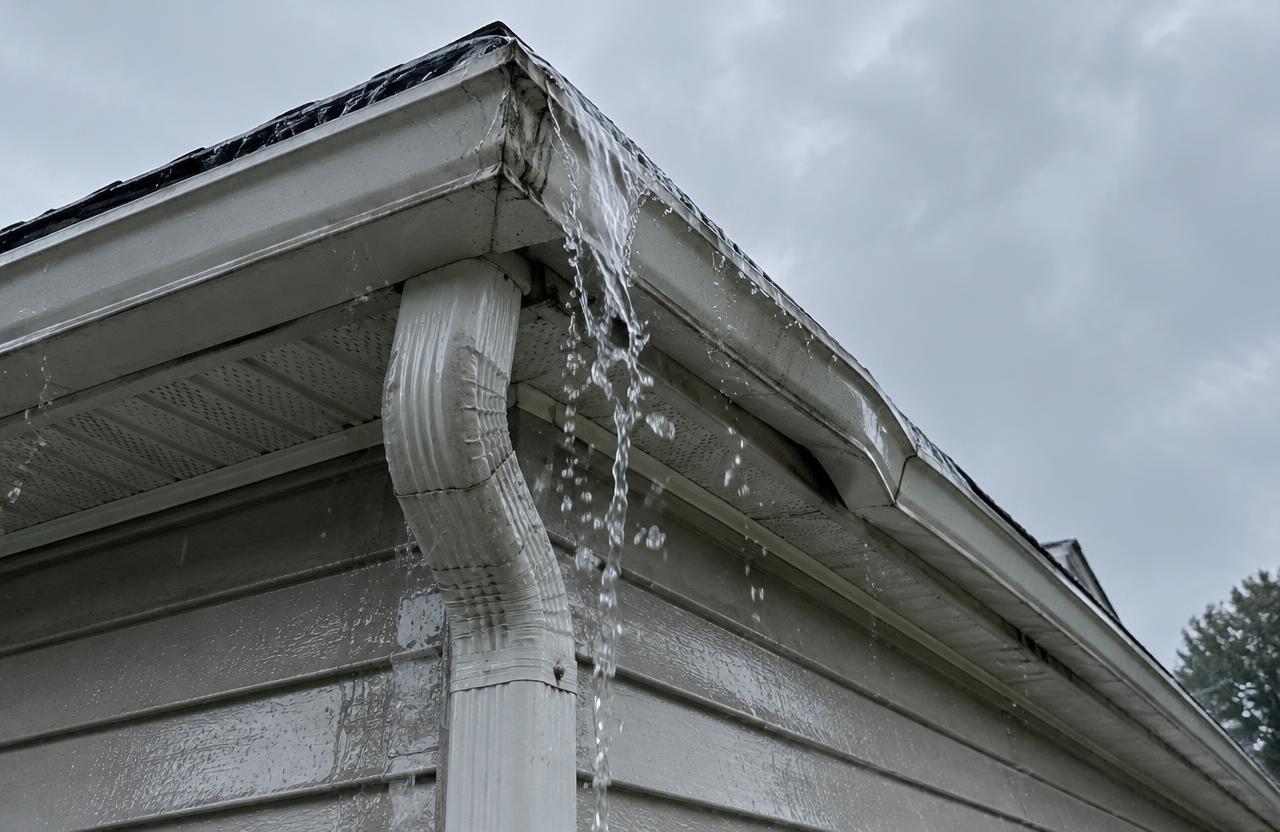
You can learn a lot without a ladder. Watch during a normal rain from a safe, dry spot, like a window, a porch or a garage door. Do not go out if you hear thunder or see lightning, or when winds are high. The Weather Service says no place outside is safe in a thunderstorm. Wait 30 minutes after the last thunder.
- Look for water pouring over the front of a gutter.
- Look for drips at seams, corners and end caps.
- Look at each downspout. Is water coming out the bottom?
- Look for spots where a gutter sags or pulls away.
- Look at the ground. Is water pooling against the house?
- Take short videos. They help a crew understand the problem.
Checks on a dry day
On a dry day, stand back from the house and look along each gutter. A straight run should look straight. Dips mean the hangers may be loose.
Look at the boards behind the gutters. Peeling paint, dark stains or soft wood suggest water has been getting behind. Look under the eaves for stains on the soffit.
Check where downspouts end. Are they connected? Do they have extensions or splash blocks? Are any crushed or blocked by mulch?
| What you see from the ground | Common cause | Usual fix |
|---|---|---|
| Water spills over the front edge | Clog, too little slope or gutter too small for the roof | Clean, re-pitch or add a downspout |
| Drips at a seam or corner | Old sealant failed | Clean and reseal the joint |
| A run droops in the middle | Loose or broken hangers | Re-hang with new hangers into solid wood |
| Water pools by the foundation | Downspout ends too close to the house | Add an extension or reroute the flow |
| Water runs behind the gutter | Missing drip edge or gutter set too low | Adjust the gutter or add flashing |
| Peeling paint or rot on the fascia board | Long-term overflow or leaks | Repair wood, then fix the gutter |
Leave ladder work to a trained crew
Most gutter injuries come from ladders, not from the gutters. Soft ground, wet rungs and reaching too far all cause falls.
If you are not comfortable on a ladder, do not climb. Never lean a ladder on a gutter, which can bend or break. Never work near power lines. A crew with the right gear can reach and check every section safely.
Common gutter repairs
Most repairs fall into a few groups.
- Resealing joints: the crew cleans old sealant from seams and corners and applies fresh gutter sealant.
- Re-hanging: loose or broken hangers are replaced. New screws go into solid wood, not rotted board.
- Re-pitching: the gutter is tilted so water flows toward the downspout instead of sitting.
- Clearing downspouts: packed leaves and seeds are flushed or pulled out.
- Adding a downspout: a long run may need another outlet to keep up with heavy rain.
- Patching small holes: small rust spots can be patched; large ones mean that section should be replaced.
Seamless gutters and sectional gutters
Sectional gutters come in short pieces joined with seams. Each seam is a spot that can leak as sealant ages.
Seamless gutters are formed on site from a coil of metal, so a long run has no seams except at corners and ends. Fewer seams mean fewer places to leak. They often cost more.
If your sectional gutters leak at many joints, a seamless replacement may make sense. If only one or two leak, resealing may be enough.
When the roof edge is part of the problem
Sometimes the gutter is fine but water still gets behind it. A metal strip called a drip edge sits at the roof's edge and guides water into the gutter. If it is missing or bent, water can run down behind the gutter and into the board.
In winter, ice dams can form at the roof edge and fill the gutter with ice. The fix for ice dams is often in the attic, with better air sealing and insulation. Our ice dam page explains more.
If water stains appear inside near an outside wall, a crew should check the roof edge, the gutter and the wall together.
Fascia and soffit damage
The fascia is the board the gutter hangs on. The soffit is the panel under the roof overhang. Both can rot when gutters leak or overflow for years.
A gutter cannot hold tight to rotted wood. So the wood often has to be fixed before new hangers go in. Ask whether the bid includes wood repair and what happens if more rot is found once the gutter comes off.
Gutter guards: help, not magic
Gutter guards are screens or covers that keep leaves out. They can cut down on cleaning, especially near big trees.
They still need care. Seeds, needles and grit can build up on top or slip through. In heavy rain, some covers let water shoot past the gutter. Ask how the guard is cleaned and how it handles a big storm.
Where the water goes after the downspout
A downspout that dumps right at the foundation can undo all the gutter's work. Extensions, splash blocks or underground pipes carry water farther away.
Underground pipes can clog or crack, too. If water backs up out of the downspout, the buried pipe may be blocked. Grading and yard drainage are a separate job. A gutter crew may refer you to a drainage or landscape pro for that part.
Questions to ask before you hire
Ask these and write down the answers.
- Which sections need work, and can you show me photos?
- Will you repair the fascia if it is rotted?
- How will you set the slope, and how will you test it?
- Are the hangers and sealant included in the price?
- What is your workmanship warranty?
- Are you registered with the state to do this work?
Getting started
Bring your rain videos and notes. Point out any water stains inside, in the basement or on the walls. That helps a crew see the full picture.
When you are ready, tell us what you see. We help homeowners across the Omaha area get gutter and drainage problems fixed the right way.
Gutters on businesses and apartments
Larger buildings may have big box gutters, scuppers through the wall or inside drains instead of hanging gutters. Water from a big roof moves fast, and a clog can back water up onto the roof.
If you manage a building, have the drains and scuppers checked with each roof inspection, and clear them often in leaf season. Our commercial roof pages explain those parts in more detail.
Gutters in winter
Cold weather brings its own gutter problems. Water that freezes in a clogged gutter adds weight and can pull hangers loose. Ice can split seams and crack downspouts.
Melting snow in the day and hard freezes at night can fill gutters with ice again and again. If your gutters hold ice for weeks, ask the crew to look at both the gutters and the attic. Ice in gutters is often linked to ice dams on the roof above.
Gutter material choices
Most home gutters are aluminum. It does not rust and comes in many colors. Steel gutters are stronger but can rust where paint wears off. Copper lasts a long time and costs much more. Vinyl is cheap but can crack in cold weather and sag in heat.
When you replace a section, matching the material matters. Some metals react with each other and corrode where they touch. Ask the crew what your gutters are made of and what they will use.
Gutter size and roof size
A big, steep roof sends a lot of water to one gutter. If the gutter is too small, it overflows in heavy rain even when it is clean. Long runs with only one downspout have the same problem.
A crew can look at how much roof drains to each gutter and suggest a bigger size or more downspouts. This is a common reason gutters overflow on newer additions or where two roofs meet.
Where two roofs meet
Valleys are the spots where two roof slopes join. They carry a lot of water into a small part of the gutter. That spot often overflows first.
A small metal piece called a diverter or a splash guard can help keep water in the gutter. A downspout near the valley can help too. Ask the crew if your valley spots need extra help.
Cleaning: how often
Homes near big trees may need cleaning in spring and fall, and maybe more. Homes with few trees may need it less. Seeds, blossoms and roof grit build up even without leaves.
A clean gutter that still overflows has a slope, size or downspout problem, not a dirt problem. That is a good clue for the crew.
How our request form works
We serve homes and businesses across the Omaha area. This website is a preview right now. The online form checks your answers, but it does not save or send them yet, so no roofer gets your request from it.
When online requests are turned on, this note will change. Until then, the form is a way to see what we will ask: your town or ZIP, what you see and what kind of help you need. We do not sell your details.
Common questions
Should I repair or replace my gutters?
Repair makes sense when a few joints leak or a section sags. Replacement makes more sense when many joints leak, the metal is rusted through or the gutters are too small for the roof. Ask for photos of the problem spots.
Do gutter guards stop all clogs?
No. Guards can keep out big leaves, but small seeds and grit can still build up. Some guards also need cleaning on top. Ask how a guard should be cleaned before you buy one.
Is water inside my house a gutter or roof problem?
It can be either. Overflowing gutters can push water into walls, the basement or behind trim. A roof leak can show up in the same places. A crew should check both before saying which one it is.
How far should a downspout drain from the house?
Enough that water flows away and does not pool by the foundation. The EPA's moisture guide says the ground should slope away from the building. Local rules may limit where you send water, so ask before you aim it at a neighbor or sidewalk.
Can I clean my own gutters?
Many people do, but ladder falls are a real risk. If you do not feel steady on a ladder, do not climb. A helper holding it does not make you steady. Have a crew do it, and never work near power lines.
Related help
Sources we checked
Official and standards pages we used to check facts on this page. Rules can change, so confirm with the source.