Quick answer
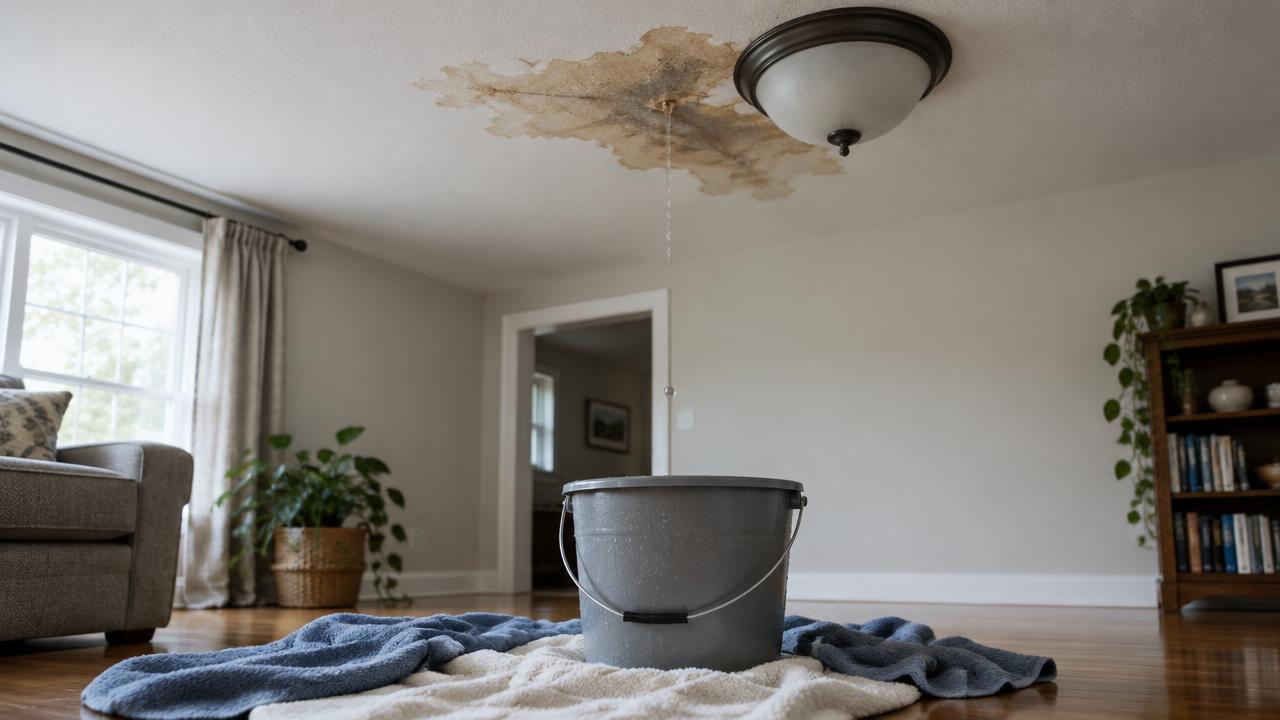
A stain on the ceiling is a clue, not a map. Water often runs along wood before it drips, so the hole on the roof may be far from the spot you see. Catch the water, keep clear of wires, take notes and have a roofer trace the real source.
The short answer
Roof leaks are tricky because water travels. It can land on the roof in one place, run down a board and drip out a few feet away. That is why the stain on your ceiling may not sit under the hole.
A good fix starts with finding the true source. Patching the wrong spot wastes money and lets the leak go on. This page helps you collect clues so a roofer can find it faster.
Safety first
If water is near lights, outlets or wires, stay back. Do not touch the wet area. Call an electrician if you cannot safely reach a dry breaker panel from a dry floor.
If a ceiling sags with water, keep people out from under it. It can fall.
Do not climb on the roof to look for the leak. Do not crawl into the attic either. Attic floors are often thin ceiling board. You can look in from the hatch with a flashlight.
What to do right now
- Catch the drip with a bucket. Put a rag in the bucket to quiet the sound.
- Move things out of the way and lay towels down.
- Take a photo of the stain. Draw a light pencil line around its edge so you can see if it grows.
- Write the date, the time and the weather, like heavy rain, wind from the west, or melting snow.
- Request a roofer to find the source.
| Clue | Possible source | Not always the roof |
|---|---|---|
| Stain near a bathroom fan or pipe | Pipe boot or vent | Could be a plumbing leak or fan duct |
| Stain near the chimney | Chimney flashing | Could be the chimney crown or bricks |
| Stain only in deep winter | Ice dam | Could be attic condensation |
| Drip only in wind-driven rain | Flashing at a wall or window | Could be siding or window trim |
| Stain near the outside wall | Roof edge or gutter overflow | Could be a clogged gutter |
Why water travels
Under the shingles is a layer of paper or synthetic sheet. Under that is the wood deck. Under that are the rafters, the long boards that hold up the roof.
Water that gets past the shingles can run along the paper, then along a rafter, before it finds a low spot to drip. On a long roof that can be several feet.
Insulation can also soak up water and spread it out. So a stain can look big even when the hole is small.
The most common leak sources
Roofers find most leaks in a short list of places. Knowing them helps you follow along.
- Pipe boots: rubber collars around plumbing pipes that crack in the sun.
- Flashing: metal at chimneys, walls and skylights that can loosen or rust.
- Valleys: where two slopes meet and a lot of water runs.
- Roof vents: covers that crack or seals that fail.
- Missing or lifted shingles: often after wind.
- Nail pops: nails that push up through the shingle above.
- Roof edges: where gutters back up or drip edge is missing.
Leaks that are not the roof
Some water stains look like roof leaks but come from somewhere else. A good roofer will say so instead of selling a roof fix.
- Plumbing leaks from an upstairs bath or a pipe in the ceiling.
- Air conditioner drain lines or pans in the attic.
- Bath fans that vent into the attic instead of outside.
- Condensation: warm, wet house air that hits cold roof wood in winter and turns to water.
- Windows or siding that let wind-driven rain in.
- Ice dams, which are a roof problem but need an attic fix too.
Clues that help find the source
Your notes can save time. Try to answer these before the roofer comes.
- Does it leak every rain, or only in heavy or windy rain?
- Which way was the wind blowing?
- Does it leak when snow melts but not in rain?
- Is the stain near a bathroom, kitchen, chimney or skylight?
- Did it start after a storm or after other work on the roof?
- Is the attic air damp or does it smell musty?
How a roofer finds a leak
A roofer starts with your clues and the spot on the ceiling. Then they look in the attic, if they can reach it safely. They look for wet wood, stains and drip trails that lead uphill.
On the roof, they look at everything above and uphill from the wet area. That includes pipe boots, flashing, vents and shingles.
For hard leaks, some roofers use a water test. One person runs a hose on one part of the roof at a time. Another watches inside. It is slow, but it can pin down a stubborn leak.
What a leak repair might include
Most leak repairs are small. A new pipe boot, a reset piece of flashing or a few new shingles is common.
Some leaks have caused damage below. Wet wood may need to be cut out and replaced. Wet insulation may need to be removed and dried or replaced.
Ask the roofer to show photos of the source, the fix and any damage they found. Ask if the price covers the inside damage or just the roof.
When leaks keep coming back
If a leak returns after a repair, the true source may have been missed. Or the patch may not have sealed well.
Call the same roofer first. Many will come back to check their work. Bring your notes and photos from each leak.
If leaks show up in many places, the roof may be wearing out. Our repair or replace guide can help you decide what to do next.
Damage to check after a leak
Water can cause problems you cannot see right away. After the leak is fixed, keep an eye on these.
- Ceiling spots that stay soft or keep spreading
- Musty smells in the attic or closets
- Dark spots on attic wood
- Paint that bubbles or peels
- Insulation that looks flat or clumped
Insurance and leaks
Many home policies treat sudden damage, like a storm, differently than slow wear. Read your policy or call your agent.
Take photos of the stain and any damage. Keep receipts. Only your insurer decides what is covered.
Omaha weather and leaks
The Omaha area has hard rains in spring and summer, and freeze and thaw in winter. Each can show a different weak spot.
A leak that only shows in winter may be an ice dam or condensation. One that shows in summer storms may be flashing or a pipe boot.
Leaks by season
When a leak shows up gives a big clue about where it comes from.
- Spring rain: flashing, pipe boots and valleys get tested by long, hard rains.
- Summer storms: wind-driven rain can push water under flashing at walls and windows.
- Fall: leaves can block valleys and gutters so water backs up.
- Winter: ice dams and attic condensation can both look like leaks.
- Snow melt: water runs slowly for hours, finding tiny gaps that rain misses.
Is it the roof or condensation?
In cold weather, warm, damp air from the house can rise into the attic. When it hits the cold underside of the roof, it turns to water or frost. Later, it melts and drips.
This can look just like a roof leak. But it often shows up on sunny days after a cold snap, not during rain. Attic wood may be damp in many spots, not just one.
The fix is often air sealing and better attic air flow, not roof work. A good roofer will tell you when the problem is not the roof.
Pipe boots: a very common source
Plumbing pipes poke through the roof to vent sewer gas. Each pipe has a boot, a rubber collar that seals the gap.
Sun dries out the rubber over the years. It cracks, and water runs down the pipe into the attic.
A new boot is usually a small job. Some roofers use boots with metal bases that last longer. Ask what they plan to use.
Flashing: the metal that seals gaps
Flashing is thin metal bent to cover the joint where the roof meets a wall, chimney or skylight. Water runs over it instead of into the gap.
Flashing can pull loose, rust or lose its sealant. Then water sneaks behind it. Chimney leaks often come from flashing, but they can also come from the bricks or the chimney top.
Ask the roofer to show photos of the flashing and explain if it can be resealed or needs to be replaced.
What not to do
- Do not smear tar on the roof yourself; it can trap water and make a real fix harder.
- Do not drill holes in the ceiling unless a pro tells you to.
- Do not ignore a small stain for months.
- Do not let anyone patch without showing you the source first.
Skylights and chimneys
Skylights and chimneys are big openings in the roof. Each one has several joints that must stay sealed.
A skylight can leak at the glass seal, the frame or the flashing around it. Some drips are really condensation on cold glass. A roofer can tell which.
A chimney can leak at the flashing, the cap on top, the crown or the bricks. Some fixes belong to a roofer and some to a chimney or masonry pro. Our chimney leak page explains the difference.
Keep notes for each leak
If the leak comes back, notes help a lot. Write the date, the weather and where water showed up. Add a photo each time.
Bring this list to the roofer. Patterns, like leaks only in east winds, point right to the cause.
How our request form works
We serve homes and businesses across the Omaha area. This website is a preview right now. The online form checks your answers, but it does not save or send them yet, so no roofer gets your request from it.
When online requests are turned on, this note will change. Until then, the form is a way to see what we will ask: your town or ZIP, what you see and what kind of help you need. We do not sell your details.
Common questions
Why does my roof only leak in some storms?
Some leaks need wind to push water sideways under flashing or shingles. Others only show in very long rains. Note the wind and rain each time it leaks. That helps a roofer find it.
Can a roof leak be fixed in the rain?
A roofer may put on a tarp or a quick patch in the rain if it is safe. The lasting repair usually waits for a dry day so materials stick and seal.
Is a small stain worth checking?
Yes. A small stain can mean weeks of slow water above it. Early fixes are usually smaller than fixing wet insulation, rot or mold later.
Could it be my air conditioner?
Yes. AC lines and drain pans in the attic can drip. So can bath fan ducts. A roofer or HVAC tech can tell them apart.
Do you help with leaks in every town you serve?
Yes. Each of our eight towns has its own leak help, and we connect you with a local roofer for your address.
Related help
Sources we checked
Official and standards pages we used to check facts on this page. Rules can change, so confirm with the source.