Quick answer
Restaurant roofs can face grease, oil and heat from kitchen exhaust. How much depends on the cooking, the fan, the filters and how often they are cleaned. Choose a membrane and repair method approved for the actual exposure. One maker's PVC example does not prove every PVC is right or every TPO is wrong. Never shut off exhaust while cooking goes on. Plan food safety, dust and timing with the restaurant.
Why restaurant roofs are different
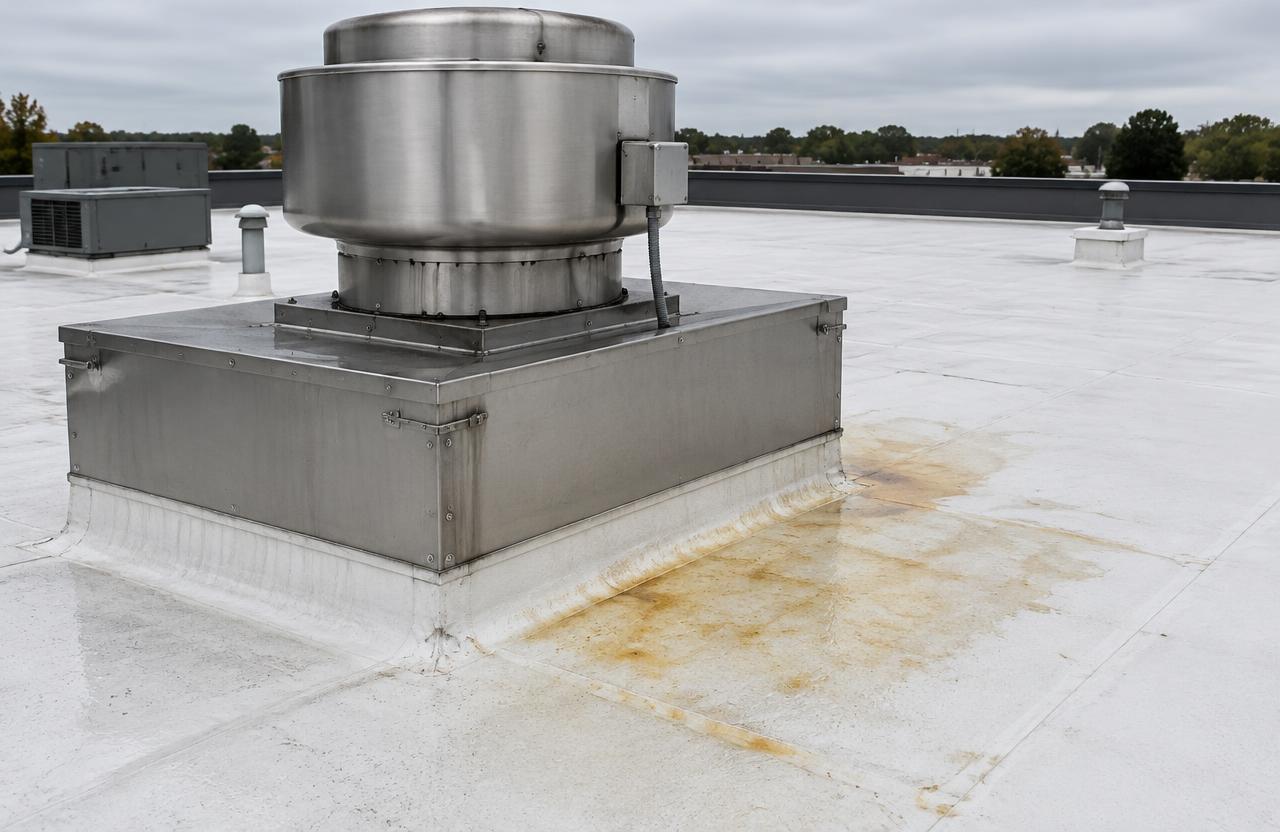
A kitchen pushes hot, greasy air up through an exhaust fan on the roof. Over time, some of that grease can land on the roof. It can soak into some roof sheets and make them swell, soften or crack.
Not every restaurant puts out the same amount. A busy fryer kitchen is not the same as a coffee shop. The fan type, filters and cleaning schedule all change the picture. So the first step is to learn what your roof is really facing.
Look at the actual exposure
Walk the roof with a qualified person, using safe access. Look around each exhaust fan. Is there a grease box or guard? Is it full? Are there stains spreading across the sheet? Is the sheet soft, swollen or cracked near the fan?
Ask the restaurant about the menu and hours. Ask the exhaust cleaning vendor how often they clean and what they find. Their notes are useful. They show how much grease is leaving the fan.
Grease boxes and guards
A grease box or guard at the base of the fan can catch much of the grease before it reaches the roof. It needs to be the right size, and it needs to be emptied or changed.
A full or missing grease box lets grease run onto the roof. Often the best first fix is not on the roof at all. It is a working grease box and a cleaning schedule. Talk to your exhaust vendor about it.
| Check | Why it matters | Who confirms it |
|---|---|---|
| How much grease comes out | Sets how hard the roof is pushed | Restaurant and exhaust cleaning vendor |
| Grease box or guard at the fan | Catches grease before it reaches the roof | Exhaust vendor |
| Membrane type and its limits | Some sheets handle grease better than others | Roof maker's papers for that product |
| Approved cleaner | The wrong cleaner can harm the sheet | Roof maker's care guide |
| Approved repair method | Repairs must bond to the aged, dirty sheet | Roof maker and roofer |
| Exhaust shutdown plan | Exhaust must run while cooking | Restaurant and fire safety team |
Choosing a membrane
Roof sheets react to grease in different ways. Some products are made to resist certain greases and oils. Carlisle's Sure-Flex PVC papers, for example, describe that kind of use.
But one product's paper does not prove a whole family. Not every PVC is suited to every grease. Not every TPO is unsuited. Each product has its own limits. Ask the bidder for the papers on the exact product and how it fits your exposure. Ask what the maker says about grease in its warranty.
No roof sheet resists every chemical without limit. Strong cleaners, solvents and heat can each cause harm. Read the limits, not just the claims.
Cleaning the roof
Grease on a roof should be cleaned off, but with care. The wrong cleaner can harm some roof sheets. Pressure washing can also do damage if done wrong.
Ask the roof maker which cleaners and methods it approves for your product. Follow that guide. Keep notes on when the roof was cleaned and what was used. That record can matter for a warranty.
Repairs on a greasy roof
Patches and welds don't stick well to dirty or grease-soaked sheets. A repair crew may need to clean the area deeply, cut out damaged sheet or replace a section.
The repair method should be approved by the maker for that sheet. Ask how the crew will prepare the area and what they will use. A patch over grease may fail fast.
Never stop exhaust while cooking
The exhaust system removes heat, smoke and grease from the kitchen. Turning it off while cooking goes on is a serious hazard.
If roof work near the fan needs the fan to stop, it must be planned for a time when the kitchen is not cooking. The restaurant, its exhaust vendor and its safety team decide this. A roof crew should never shut down or disconnect exhaust on its own.
Fire safety on the roof
Grease buildup near a fan is a fire risk. Some roof work uses heat, such as hot-air welding or torches on certain roofs. Heat near grease is dangerous.
Roof assemblies have fire ratings from tests. But no roof is fireproof. Hot work near kitchen exhaust needs a plan from qualified pros, with fire watch where required. Clean grease off before heat work. This is never a do-it-yourself job.
Food safety during the job
Roof work can shake loose dust and debris inside. In a kitchen or dining room, that is a food safety concern.
Plan how food areas will be protected. That may mean covering, moving food, sealing ceiling areas or pausing service in some zones. These steps are project-specific. Your health and safety advisers should help decide.
The FDA publishes a model Food Code and now lists a 2026 edition. A model code is not the same as local law. Local adoption is a separate step. Ask the local health office which rules apply.
Smells and air intakes
Some roof products give off smells while going on or curing. Kitchen makeup air units and other intakes can pull those inside.
The EPA's guide for building owners stresses planning for indoor air during building work. Work with the restaurant's HVAC vendor. Decide whether intakes near the work need changes during the job, and when work should happen.
Scheduling around service
Restaurants have peaks: breakfast, lunch, dinner, weekends. Roof work over the kitchen or dining room affects each one differently.
Build the schedule with the restaurant. Some work may fit closed hours. Some may need a short pause in service. Agree on daily close-up so the roof is watertight each night. Agree on who to call if a leak shows up.
Care after the job
Set a regular check of the area around each fan. Empty or change grease boxes on schedule. Clean the roof with approved methods. Log each visit.
Ask exhaust and HVAC vendors to use walk pads and report any damage. A small problem near a fan is easier to fix early than late.
Other rooftop gear on restaurants
Restaurants often have more than one fan. There may be a makeup air unit, HVAC units, walk-in cooler gear and gas lines. Each one needs flashing that fits the roof.
Gas lines on the roof need care. They should be supported off the roof surface on proper supports, not lying on the sheet. Only qualified pros should move or work near gas lines. Mark them on the roof plan for every crew.
Signs that grease is hurting the roof
Look for stains that spread out from the fan. Look for spots where the sheet feels soft, looks swollen or has small cracks. On some roofs, grease can also cause seams to open.
These signs don't tell you how deep the damage goes. A roofer may need to test the sheet or cut a sample. Don't walk on soft areas. Keep the area marked until a pro has looked.
Leaks over the kitchen or dining room
A leak over food or a hot line is a food safety and fire concern. Stop using the affected area if water is dripping near food, cooking gear or electrical gear. Move food away and cover what you can.
Write down where and when it leaked. Call the person on your leak plan. Your health and safety advisers can tell you what to do with any food that got wet. A roofer should find the cause and note it, not just patch the stain.
Lease and franchise rules
Many restaurants rent their space. The lease says who handles the roof and the exhaust system. A franchise may also have its own rules for vendors and work hours.
Read these before planning work. The landlord, tenant and franchise may each need to agree. Get approvals in writing so the job doesn't stall halfway through.
Questions to ask a bidder
Which roof sheet do you suggest for this exposure, and what do its papers say about grease? How will you handle the area around each fan? What cleaner and repair method does the maker approve?
How will you plan work around cooking hours and exhaust? How will you protect food areas from dust? What is your plan for hot work near grease? Who is my contact each day?
Records to keep for a restaurant roof
Keep the roof product name, install date and warranty. Add the exhaust cleaning reports and grease box service notes. Add roof cleaning dates and the cleaner used.
These records show how the roof has been cared for. They help if you file a warranty claim. They also help a new roofer understand the roof's history before making a repair.
How we serve restaurant owners
We are serving restaurant owners and managers across the Omaha area. Use the form on this page to ask for a roof check or bid. Tell us about the kitchen, the fans and your busy hours.
We will plan around your service, your exhaust system and your food safety needs, not the other way around.
Common questions
Is PVC always best for a restaurant roof?
Not always. Some PVC products are made to resist certain greases and oils better. Carlisle's Sure-Flex PVC papers are one example. But that does not make every PVC right or every TPO wrong. Check the exact product's papers against your exposure.
Can the kitchen hood be turned off during roof work?
Never while cooking goes on. Exhaust removes heat, smoke and grease. Work near the fan must be planned for times when the kitchen is not cooking, with the restaurant and its safety team.
Is any roof fireproof?
No. Roof assemblies have fire ratings from tests, but no roof is fireproof. Grease buildup is also a fire risk. Keep the exhaust system cleaned by a qualified vendor.
Which Food Code does Omaha use?
We don't state that here. The FDA lists a 2026 model Food Code, but local adoption is a separate step. Ask the local health office which rules apply to your restaurant.
Can we keep serving during roof work?
Sometimes, with a careful plan. Dust, debris and smells near food areas may mean a pause in some cases. That depends on the work and the space. Plan it with the restaurant and its health and safety advisers.
Related help
Sources we checked
Official and standards pages we used to check facts on this page. Rules can change, so confirm with the source.