Quick answer
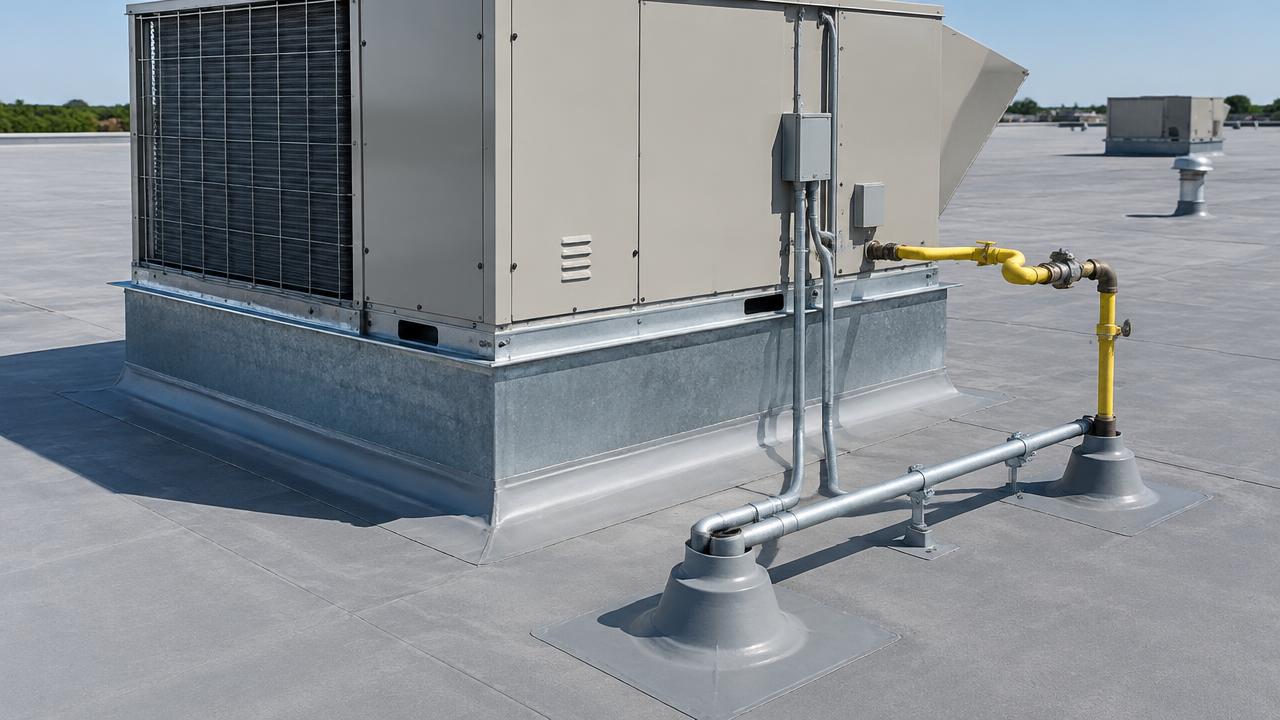
A penetration is anything that goes through the roof: pipes, vents, wires, gas lines, curbs for air units, and supports. Each one is a hole that must be sealed. Leaks at these spots are common. The fix needs flashing that fits the roof type, and it often needs the roofer and other trades to work together.
What counts as a roof penetration
A flat commercial roof is often busy. It may hold air units, exhaust fans, plumbing vents, gas lines, electric conduit, satellite dishes, solar racks and signs. Anything that passes through the roof sheet is a penetration. Anything that sits on the roof and is fastened through it is one too.
Every penetration is a hole in the roof. Each hole needs flashing. Flashing is a sleeve, boot, or wrap that joins the roof sheet to the item. It must keep water out while the roof and the item move a little with heat and cold.
We serve building owners and managers across the Omaha area. Leaks at penetrations are one of the most common flat roof calls we see.
Why penetrations leak
Penetrations leak for a few main reasons. Often more than one is at work.
- Old flashing: boots crack and sealants dry out in the sun.
- Wrong parts: flashing made for one roof type used on another.
- Short flashing: the roof sheet does not run high enough up a curb.
- Movement: units shake, pipes grow and shrink with heat, and the seal tears.
- Foot traffic: service workers step on boots and corners.
- New work: another trade cuts a hole and seals it with caulk only.
Flashing must fit the roof type
On TPO and PVC roofs, pipe boots are often made of the same material and welded in place. On EPDM roofs, boots are usually rubber and set with primer and tape. On modified bitumen and built-up roofs, flashing may be metal, sheets set in bitumen or other parts.
Using the wrong part can cause leaks. Some sealants and parts do not stick to some sheets. Some can harm them. Membrane makers, like Carlisle, publish detail drawings for their roofs. Those show how each penetration should be flashed. A crew should follow the drawing for your roof.
| Penetration | Common flashing | What often goes wrong |
|---|---|---|
| Round pipe or vent | Pipe boot or sleeve made for that roof type | Cracked boot, loose clamp, sealant dried out |
| Air unit curb | Roof sheet run up the curb sides with metal cap | Open corners, short flashing height, loose cap |
| Odd-shaped item or group of pipes | Pitch pan (a box filled with sealer) or a custom detail | Sealer shrinks or cracks and pulls away |
| Gas line or conduit support | Support pads or stands, plus flashed openings where lines go through | Lines sitting right on the roof and wearing it |
| Roof hatch or skylight | Curb flashing like an air unit | Loose corners, damage from foot traffic |
Air unit curbs
Most rooftop air units sit on a curb. A curb is a raised metal box fastened to the roof. The roof sheet should run up the sides of the curb and be held under a metal cap at the top. Corners are a weak point. They need corner pieces made for the roof type.
Leaks at curbs often come from open corners, loose metal caps, or flashing that does not run high enough. Water may also get in through the unit itself, not the roof. Condensate lines, service panels and duct seals can all leak inside. A roofer and an air unit tech may both need to look.
Pipes, vents and pitch pans
Round pipes and vents are usually flashed with a boot or sleeve. The boot hugs the pipe. A clamp or a storm collar holds the top tight. Boots wear out and crack, and clamps loosen.
Odd shapes are harder. A group of wires or a bent pipe may not fit a boot. Some roofs use a pitch pan. That is a small metal box around the item, filled with sealer. Pitch pans can work, but the filler shrinks and cracks with time. They need regular checks and refilling. Some makers offer other details that may last longer.
Gas lines, conduit and supports
Gas lines and electric conduit often run across a roof to reach units. They should sit on supports made for roofs, not right on the roof sheet. Lines lying on the roof can rub and wear a hole. Wood blocks can rot and trap water.
Where a line goes down through the roof, it needs a flashed opening. Never move, cut or bend a gas line or electric line to reach a leak. Only licensed trades should touch them. A roofer can work around them and coordinate with the right trade.
Working with other trades
Many penetration leaks start when another trade adds or moves something. An air unit swap, a new exhaust fan, or a new cable line can all mean a new hole. If that trade seals it with caulk only, it may leak soon.
A simple rule helps: no new roof holes without the roofer in the plan. Ask the trade to call the roofer before they cut. Ask the roofer to flash the new opening the way the maker shows. Keep notes in your roof log on who did what and when. That helps if a leak shows up later and someone has to fix it.
If your roof has a maker warranty, new holes may need to be done by an approved crew. Check before work starts.
Finding which penetration leaks
Water can travel under the roof sheet before it drips inside. A drip below one unit may come from a pipe ten feet away. A crew often starts at the penetrations closest to the drip, then works outward.
They look at boots, clamps, corners and caps. They may do a careful water test on one spot at a time. Some use electronic leak tools on certain roofs. Our leak detection page explains those methods and their limits. No method can promise to find every leak on the first try.
What to do while you wait for help
If water is coming in, act right away. Move people, papers and equipment away from it. Put a bucket under the drip. Turn off power to any wet electrical gear from a dry spot, or have an electrician do it. Do not touch wet electrical panels.
Write down where the drip is, which unit or pipe is above it, and when it started. The EPA says to dry wet areas fast to help stop mold. Do not go on the roof in rain, ice or wind. Call a crew to look.
Pipe boots on single-ply roofs
Many single-ply roofs use premade pipe boots. They come in set sizes and slide over the pipe. The base is welded or taped to the roof, and a clamp holds the top. If a pipe is too big, too small or bent, a premade boot may not fit. Then the crew may build a field-wrapped detail from flashing sheet, following the maker's drawing.
Boots can split from sun, cold and movement. Clamps can rust or loosen. A quick look at each boot on every upkeep visit can catch these early. Ask the crew to note the size and type of each boot in your roof log, so the right part is ready next time.
How tall flashing should be
Flashing has to run high enough up a curb or wall to stay above water and snow. If it is too short, water can spill over the top during heavy rain or when snow melts. Roof makers set flashing heights in their detail drawings, and local codes may also apply.
Older roofs sometimes got a new layer without raising the curbs. That leaves less flashing height than before. If curbs look low compared to the roof, ask the crew to measure and tell you if they need to be raised during the next big repair or new roof.
Penetrations and roof warranties
Many roof warranties cover the roof but not damage from other trades. If an air unit crew cuts a new hole and it leaks, the roof maker may not cover it. Some warranties also need the maker to be told about new openings.
Before any new rooftop work, read the warranty or call the maker. Ask your roofer to do or check the new flashing. Keep their report. This one step can save a long argument later about who pays for a leak.
Planning for new rooftop gear
Adding solar, new air units, antennas or signs means new weight and new holes. A design pro may need to check that the roof can carry the new gear. The roofer should plan where the openings go and how each will be flashed.
Group openings when you can. Fewer holes mean fewer places to leak. Place gear so water can still flow to the drains. Leave room around units for workers and for future roof repairs. Good planning up front costs less than chasing leaks later.
Busy roofs need more checks
A roof with many units, pipes and service visits wears faster around those parts. Upkeep plans for busy roofs often include a check after each service visit. A simple sign-in sheet at the roof hatch can help track who went up and when.
After any rooftop service, ask the crew to note anything they moved or opened. Then have the roofer check those spots on the next visit. Small damage found early is often a quick fix.
What a good penetration repair report includes
Ask for a short written report after the visit.
- Photos of each penetration checked, before and after.
- Which flashing was replaced or redone, and with what part.
- Any item that leaked from the unit, not the roof, flagged for the right trade.
- Lines or pipes sitting on the roof that need supports.
- Any pitch pans that need refilling soon.
- A note for your roof log.
Common questions
Why do leaks happen so often around air units?
Air units have many parts in one spot: the curb, pipes, wires and service panels. Workers walk around them often. The unit can shake. Each of these can strain the flashing over time.
Is a pitch pan a bad detail?
Not always. Pitch pans can work for odd shapes. But the filler can shrink or crack and needs regular checks. Some makers prefer other details when they fit.
Who fixes a leak at a new air unit?
Often the trade that installed the unit and the roofer need to talk. The roofer usually does the flashing. The unit installer handles the unit. Your contract may say who is responsible.
Can we seal it with caulk?
Caulk is not a full flashing. It may slow water for a short time. A lasting fix uses flashing parts that fit the roof type and the penetration.
Should we add new roof openings ourselves?
No. Any new hole should be planned with the roofer first. That helps keep the roof warranty and makes sure the right flashing is used.
Related help
Sources we checked
Official and standards pages we used to check facts on this page. Rules can change, so confirm with the source.