Quick answer
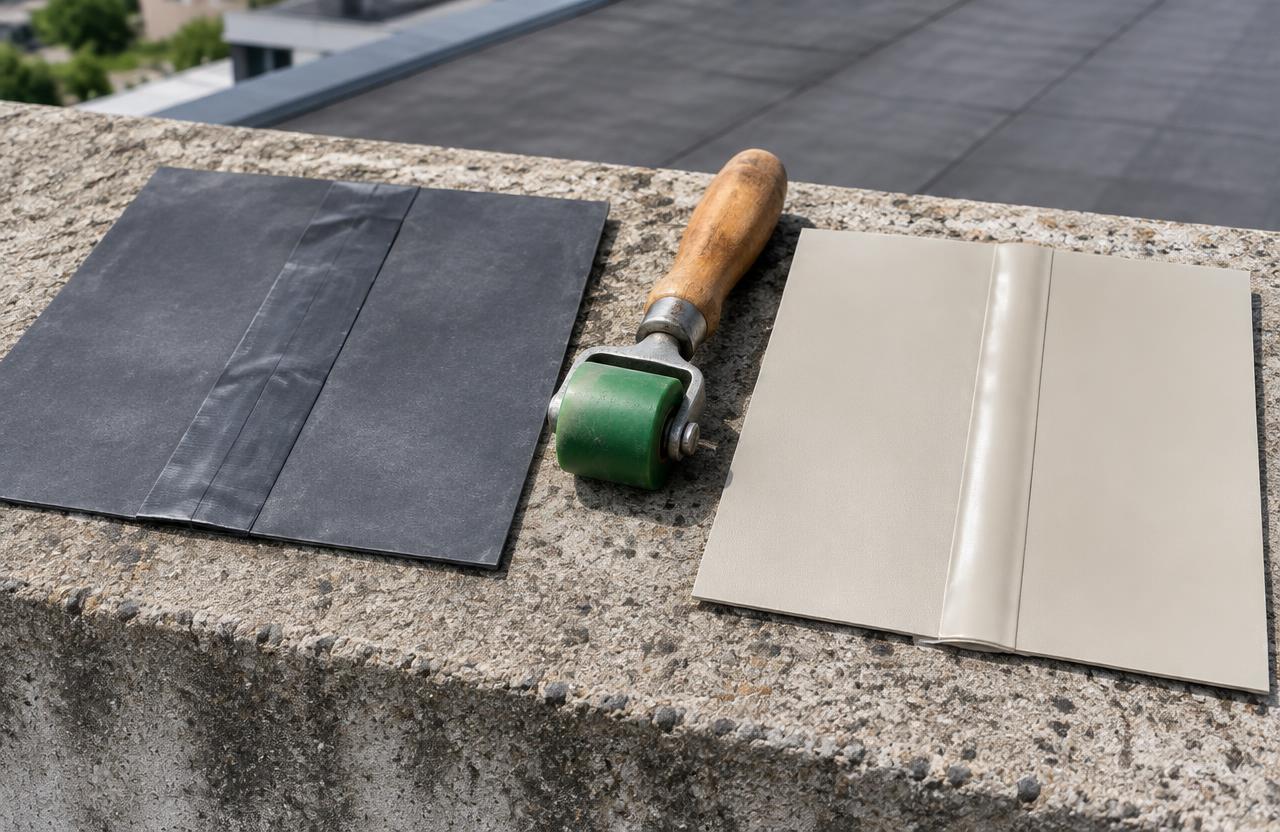
TPO and EPDM are both single-ply roofs, but they join and repair differently. TPO is a thermoplastic sheet whose seams are welded with hot air. EPDM is a rubber sheet whose seams are commonly joined with approved tapes or adhesives. Neither one wins on every roof. The right pick depends on the full assembly, the building and the exact products. Not all EPDM is black, and not all TPO is white.
Both are single-ply roofs
TPO and EPDM are both large sheets laid over insulation on low-slope roofs. That's why they're often compared.
But they're made of different materials. That changes how seams join, how repairs work and which accessories go with them. Carlisle's product pages for each show the range of choices.
What TPO is
TPO is a thermoplastic sheet. Thermoplastic means it softens with heat and can be welded. Seams are joined with hot-air welders.
TPO comes in different thicknesses and colors. Many are white or light, but other colors exist. Each product has its own specs.
What EPDM is
EPDM is a synthetic rubber sheet. It doesn't weld with heat. Seams are commonly joined with approved seam tapes or adhesives.
Many EPDM roofs are black, but white versions exist. Thickness and reinforcement vary by product.
| Topic | TPO | EPDM |
|---|---|---|
| What it is | Thermoplastic single-ply sheet | Synthetic rubber single-ply sheet |
| How seams join | Hot-air welding | Approved seam tapes or adhesives, per maker |
| Common colors | Often white or light, other colors exist | Often black, white versions exist |
| How it's held down | Fastened, adhered or other, by system | Fastened, adhered or ballasted, by system |
| Repairs | Welded patch where the sheet still welds well | Cleaned, primed, taped patch per maker |
| What decides the pick | Full assembly, building use, maker approval | Full assembly, building use, maker approval |
Seams: weld versus tape
A TPO seam is welded. A good weld fuses the two sheets. Crews probe welds to check them.
An EPDM seam uses tape or adhesive, applied after cleaning and priming. Carlisle's adhesive quick reference guide lists which products go with which uses. Using the wrong one can fail. Both methods work when done right with approved materials.
The full assembly matters most
The membrane is only the top layer. The deck, insulation, cover board, attachment and flashings all affect how the roof performs.
A great membrane over a poor assembly can still fail. Compare full assemblies, not just membrane names.
How each is held down
Both can be fastened or fully adhered. EPDM is also often ballasted with stones or pavers, if the building can carry the weight.
Each method has its own wind design and cost. Ask which method is quoted and why.
Color and reflectivity
Light roofs reflect more sunlight. That can lower roof surface heat. But the effect on your yearly energy bill depends on insulation, building use and climate.
We don't claim a set energy benefit in the Omaha area. If energy matters, ask for an analysis based on your building.
Repairs over time
TPO repairs often use welded patches. Older TPO can be harder to weld and may need deep cleaning or special prep.
EPDM repairs often use cleaned, primed and taped patches. Each maker approves specific repair products. Use those, not a guess.
No blanket rules on mixing
You may hear that one membrane's products never work with another. That's too simple. Some products are made for one type only. Others may have approved cross uses.
The safe rule is to use materials the maker approves for the exact membrane and detail. Check the guide or ask the maker.
Chemicals and grease
Some roofs face oils, grease or chemicals. Neither TPO nor EPDM resists everything.
Check the exact product's data for the substances on your roof. Our TPO vs PVC guide covers restaurant and chemical exposure more.
Hail and foot traffic
Hail results depend on the whole assembly. A cover board and thicker membrane can help. No roof is hail proof.
Foot traffic from HVAC techs can damage any roof. Walk pads help. Ask how the system handles traffic.
Cost depends on the system
We don't say which is cheaper. Price depends on the product, thickness, attachment, insulation, flashing and labor.
Get bids for named systems. Compare them line by line.
Crew skill matters
Welding TPO and taping EPDM both need skill. A crew used to one may be less skilled at the other.
Ask which system the crew installs most. Ask about training and how seams are checked.
Warranties
Maker warranties differ by product, thickness and system. Some need certain installers or inspections.
Compare what each warranty covers, for how long and with what upkeep. Read the exclusions.
Replacing or matching an existing roof
If you're adding onto a roof or replacing part of it, tying new to old matters. Joining TPO to EPDM needs approved details.
Ask how the tie-in will be done and which maker approves it.
Questions to ask each bidder
Which exact product and thickness? What full assembly? How is it held down? How are seams joined and checked?
What repair materials does the maker approve? What warranty comes with it? Why this membrane for this building?
How each one handles heat and cold
Roofs get hot in summer sun and cold in winter. Both TPO and EPDM are made to flex with these changes, but each product has its own limits.
The way the roof is held down also matters. A roof fastened only at the seams moves in a different way from one glued down all over. Ask how the system handles heat and cold on your building.
Flashing around units and walls
Most leaks start at details, not in the open field. Walls, curbs, pipes and drains each need flashing that fits the membrane.
TPO flashings are often welded. EPDM flashings often use tape or uncured rubber made for it. Ask how each detail will be done. Ask to see the maker's detail drawings.
Thickness choices
Both TPO and EPDM come in more than one thickness. A thicker sheet may resist wear better and may cost more.
But thickness alone doesn't decide how a roof works. The assembly, details and install matter too. Ask why a certain thickness was chosen for your roof.
Older roofs and repairs
As TPO ages, its surface can be harder to weld. A crew may need to clean it well, or cut in a new piece. As EPDM ages, it may need deep cleaning and primer before tape will stick.
Ask how a crew will test whether a repair will hold on your roof. A quick patch on an old, dirty sheet may not last.
Roof traffic and walk pads
Techs walk on roofs to service units. Their boots, tools and dropped screws can cut or wear the sheet.
Walk pads made for your membrane help. They should go on paths to units and hatches. Ask if the bid includes them and which kind.
Ponding water
Water that sits on a roof for a long time can stress any roof. Fixing slope and drains often matters more than which membrane you pick.
Ask how the bid handles low spots. Tapered insulation or drain changes may be needed. Our ponding water page explains more.
Recover over an old roof
Some jobs put a new TPO or EPDM roof over an old one. That may be allowed only if the old roof is dry and sound, and local rules allow the extra layer.
Ask for a moisture survey before a recover. Ask the maker if the new system is approved over what is there now.
Making the choice with your team
List what matters most for your building. That might be grease, foot traffic, color, how the roof ties to other parts or a known installer.
Then ask bidders to explain how their system fits that list. A clear reason is better than a general claim that one type is best.
Records to keep
Keep the product name, thickness, install date, warranty and detail drawings. Add photos of the roof when it was new.
When repairs happen, note which products were used. This helps the next crew pick the right repair parts.
Common myths
You may hear that TPO always beats EPDM, or the other way around. You may hear that one never leaks at seams, or that one always lasts longer. These are sales lines, not facts.
Both can work well. Both can fail when put on badly. What matters is the exact product, the whole roof build and the crew. Ask for proof of any claim in writing.
Ballast and weight
Some EPDM roofs are held down with stones or pavers. This is called ballast. It adds a lot of weight.
The building has to be able to carry it. An engineer may need to check. Ballast also makes leaks harder to find. Ask about these trade-offs if a ballasted roof is quoted.
Safety on the roof
Hot-air welders and adhesives each have their own safety rules. Crews need fall protection at edges and skylights. Some glues give off strong smells.
Ask how the crew will keep fumes away from air intakes. Ask how they will keep people below safe. Don't send your own staff up to check.
A short way to decide
First, fix what the roof needs no matter which sheet you pick. That means dry layers, good drains and a sound deck. Then think about what the roof faces: grease, foot traffic, ponding or tie-ins to other roofs.
Next, ask two or three bidders to quote named systems. Ask each one why their choice fits your building. Pick the bid with the clearest reasons, a full scope and a crew that knows that system well. The category name should come last, not first.
How we serve owners choosing a membrane
We are serving building owners across the Omaha area. Use the form on this page to ask for a roof check and bid.
We will explain why a membrane fits your building, based on the full assembly and how you use it.
Common questions
Which is better, TPO or EPDM?
Neither wins on every roof. The building, the full assembly, the exact products and the crew's skill matter more than the category. Compare named systems.
Which lasts longer?
We don't give a lifespan for either. Life depends on the product, thickness, install, climate, traffic and upkeep. Compare warranties and specs instead.
Is a white roof better for energy?
A light roof reflects more sun, but the effect on your yearly energy use depends on the building, insulation and climate. Reflectivity alone doesn't prove a benefit for your building.
Can you repair EPDM with TPO materials?
Use repair materials approved by the maker for the exact membrane. Don't mix products on a guess. The maker's guide lists what works.
Is either one hail proof?
No. Some assemblies test better for hail, often due to the cover board and thickness. No roof is hail proof.
Related help
Sources we checked
Official and standards pages we used to check facts on this page. Rules can change, so confirm with the source.