Quick answer
TPO and PVC are both thermoplastic roof sheets that join with hot-air welds. But their chemistry, accessories and repairs are not always interchangeable. Pick based on what your roof is actually exposed to and the exact products in the full assembly. A chemical-resistance claim is never blanket approval for every substance, strength, heat and time. One maker's restaurant PVC does not make every PVC right or every TPO wrong.
Both are thermoplastics
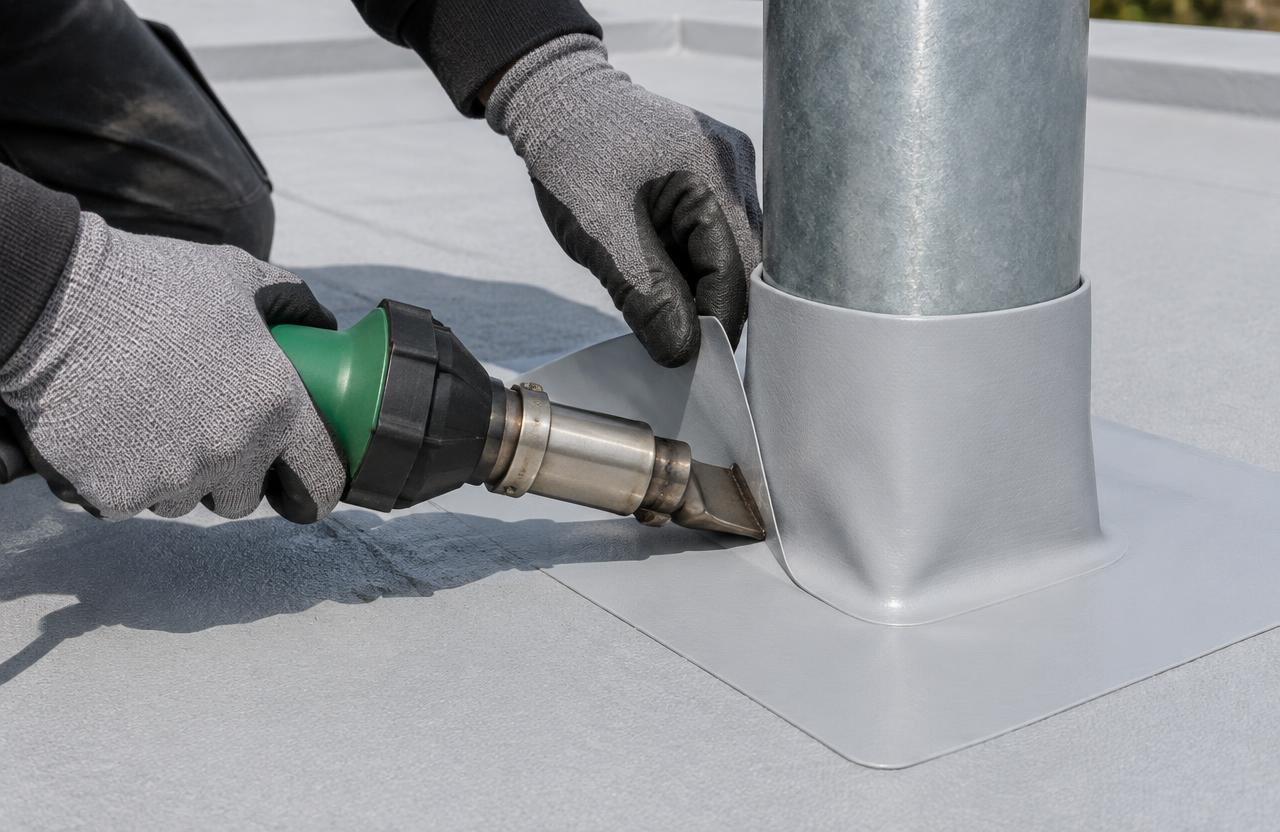
TPO and PVC are both thermoplastic sheets. They soften with heat, so seams are joined with hot-air welds. That's why they're often grouped together.
But they're made from different base materials. Carlisle's thermoplastics field guide covers both and shows that steps and parts can differ.
Different chemistry, different parts
Because their chemistry differs, accessories made for one aren't always right for the other. That includes flashings, pipe boots, corners and some cleaners.
Use parts made and approved for your exact membrane. Don't assume a TPO part works on PVC or the other way around.
Repairs need matching materials
Repairs on either roof often use a welded patch. The patch should match the membrane type and be approved by its maker.
Older sheets can be harder to weld. A crew may need to clean deeply or use special prep. Ask what the maker requires for your roof's age and condition.
| Exposure on your roof | What to check | Who confirms |
|---|---|---|
| Kitchen grease and oils | Product data for that grease type | Membrane maker |
| Process chemicals or fumes | Substance, strength, heat and contact time | Membrane maker with your facility data |
| Mostly rain, sun and snow | Full assembly fit, attachment and details | Designer and maker specs |
| Heavy foot traffic | Walkways and cover board | Designer and roofer |
| Tie-in to an existing roof | Approved transition details | Maker of each membrane |
Start with the real exposure
The best way to choose is to look at what your roof actually faces. A roof over an office faces mostly weather. A roof over a restaurant or plant may face grease, oils or fumes.
Write down what lands on the roof, how much and how often. That list guides the choice more than any general claim.
Grease and restaurants
Kitchen exhaust can put grease on a roof. Some membranes handle certain greases better.
Carlisle's Sure-Flex PVC papers describe use where grease is present. That's one product's guidance, not a rule for all PVC. Some TPO products also list resistance to certain substances. Check the exact product for your exposure.
Chemical resistance is never blanket
A data sheet may say a membrane resists certain chemicals. That resistance depends on the substance, how strong it is, how hot it is and how long it stays.
A claim for one condition doesn't cover others. Give the maker your real exposure data and ask for written guidance.
Fire ratings belong to assemblies
Fire ratings come from testing a full roof assembly: deck, insulation, cover board and membrane put together a set way.
Don't rank TPO or PVC on fire by name. Ask for the rated assembly being quoted.
Durability depends on the product
Thickness, reinforcement, the exact formula and the install all affect how long a roof lasts. So do traffic and upkeep.
We don't rank one category above the other on durability. Compare named products and their warranties.
Energy claims need context
Both often come in white or light colors that reflect sun. The effect on your energy use depends on your building, insulation and climate.
We don't claim a set energy benefit. Ask for an analysis for your building if it matters.
Tying into an existing roof
Joining a new PVC roof to an old TPO roof, or the reverse, needs care. The two don't weld together as a general rule.
Ask for a transition detail approved by the makers involved. Ask how it'll be checked.
The full assembly still matters
The membrane is only the top layer. Insulation, cover board, attachment, flashing and drainage all affect performance.
Compare full assemblies in each bid, not just the membrane name.
Cleaning and upkeep
Grease and dirt should be cleaned off with methods the maker approves. The wrong cleaner can harm a membrane.
Ask for the maker's care guide. Keep a log of cleaning dates and products used.
Cost comparisons
We don't say which is cheaper. Prices depend on the product, thickness, assembly, accessories and labor at the time.
Get bids for named systems and compare line by line.
Warranties
Maker warranties differ by product and system. Some exclude certain exposures unless approved in writing.
If your roof faces grease or chemicals, ask whether the warranty covers that exposure. Get it in writing.
Crew skill
Welding both materials takes skill and the right settings. Settings may differ between TPO and PVC.
Ask which the crew installs most, how they test welds and how they set their welders.
Questions to ask each bidder
Which exact product and thickness? What exposure did you plan for? What does the maker's data say about it? What accessories are included?
Is there a fire-rated assembly? How will tie-ins be done? Does the warranty cover our exposure?
What a field guide covers
Makers publish field guides for their crews. They show how to weld, how to set up corners and how to finish pipes and curbs.
Carlisle's guide for its TPO and PVC sheets is one example. It shows that each type has its own steps in places. Ask which guide your crew follows.
Welding settings
Hot-air welders are set for heat and speed. The right settings depend on the sheet, its thickness, the weather and the tool.
Crews often run test welds at the start of each day. Then they pull them apart to check. Ask if your crew does this and keeps notes.
Checking welds
After welding, crews often run a probe along each seam to find gaps. Gaps get fixed before the job ends.
Ask how seams will be checked. Ask for a final walk with the crew lead. Clear checks lower the risk of seam leaks later.
Roofs near plants and vents
Some buildings vent fumes or steam onto the roof. Over time, this can affect some sheets.
Tell bidders what comes out of each vent. Ask the maker which sheet fits. Ask if the warranty covers that use.
Older roofs and repairs
Aged sheets can be harder to weld. Dirt, grease and wear all get in the way. A crew may need to clean hard or cut in new pieces.
Ask how the crew will check that a repair will hold. Ask which repair parts the maker approves for your sheet's age.
Color choices
Both TPO and PVC come in white and other colors. Color can matter for looks, glare near windows or local rules.
Ask which colors each product comes in. Ask if color changes the warranty or the price.
Thickness choices
Both come in more than one thickness. A thicker sheet may handle wear better. It may also cost more.
Thickness is only one part of the choice. The details and install matter just as much. Ask why a thickness was picked for your roof.
Ponding and drains
Water that sits on a roof for long periods can stress any sheet. It can also hold dirt or grease against the roof.
Fixing slope and drains often matters more than which sheet you pick. Ask how each bid deals with low spots.
Keep records
Keep the product name, thickness, install date, warranty and detail drawings. Note what the roof is exposed to.
When repairs happen, write down which parts were used. This helps the next crew match the right materials.
Common myths
You may hear that PVC is always best near grease, or that TPO is always cheaper. You may hear that one always lasts longer. These are sales lines, not facts.
What counts is the exact product and what it faces on your roof. Ask any bidder to show proof of a claim in writing, from the maker.
Gather your facts first
Before you ask for bids, write down what you know. How old is the roof? What is on it? What comes out of the vents? Where does water sit after rain?
Share the same list with each bidder. Then their answers are easier to compare. It also helps the maker give clear advice.
Safety on the roof
Hot-air welders get very hot. Crews need fall protection at edges and skylights. Grease near vents can catch fire if heat gets close.
Ask how the crew will handle heat near grease and vents. Ask how they will keep people below safe. Never shut off a kitchen fan while cooking goes on.
If you have both on one building
Some buildings have TPO on one part and PVC on another. That can happen after an add-on or a partial job.
Keep a map that shows which is where. Give it to every repair crew. That way they bring the right parts for each roof.
A short way to decide
First, fix what the roof needs no matter which sheet you pick. That means dry layers, good drains and a sound deck. Then list what lands on the roof and how often.
Next, send that list to two or three bidders. Ask each one to name the exact product, show the maker's data for your exposure and explain the full roof build. Pick the bid with the clearest proof and the most complete scope. Don't pick on the sheet's name alone.
Questions for the maker
If your roof faces grease, oils or fumes, you can ask the maker directly. Tell them the substance, how much, how hot and how often it lands on the roof.
Ask if their product fits and if the warranty covers it. Ask for the answer in writing. Keep it in your roof file.
How we serve owners choosing TPO or PVC
We are serving building owners across the Omaha area. Use the form on this page to ask for a roof check and bid. Tell us what lands on your roof.
We will match the membrane to your real exposure and the maker's written guidance.
Common questions
Is PVC always better for restaurants?
No. Some PVC products are made for certain greases, and Carlisle's Sure-Flex PVC papers are one example. That doesn't make every PVC suitable or every TPO unsuitable. Check the exact product against your exposure.
Can I weld TPO to PVC?
Not as a general rule. They're different materials. Joining them needs a detail approved by the makers involved.
Which is cheaper?
We don't rank them on price. Cost depends on the exact products, thickness, assembly and labor. Compare named bids.
Which is more fire resistant?
Fire ratings belong to tested assemblies, not membrane names. Ask for the rating of the full assembly being quoted.
Does chemical resistant mean it handles anything?
No. Resistance depends on the substance, its strength, the heat and how long it sits. Give the maker your real exposure data.
Related help
Sources we checked
Official and standards pages we used to check facts on this page. Rules can change, so confirm with the source.