Quick answer
We are serving Bellevue, Nebraska homes and businesses with roof repair. A good repair starts by finding where water really gets in. That spot is often not right above the stain. Get a written scope that names the source, the fix, and what happens if bad wood turns up. Bellevue's published code skips the permit only for small repairs. They must add up to one roofing square (100 square feet) or less, on a roof with one layer. Work past that needs a talk with city permit staff about your address and job.
The short answer for Bellevue roof repair
A roof repair should fix the real cause, not just the stain. In Bellevue, that means three things. First, the roofer finds the true way in. Second, you get a written scope you can check. Third, someone confirms whether a permit applies before work starts.
This page is for one leak or one damaged spot. If your whole roof is worn out, read our Bellevue roof replacement guide instead. If you are not sure which you need, our repair or replace guide can help you sort it out.
We are serving Bellevue. On this preview, the request form does not save or send anything yet. For now, use this page to plan. Make notes, take photos, and list your questions.
Step 1: Keep people and the home safe today
Safety comes before any fix. Please do not climb on the roof, even to look. Wet shingles are slick, and falls hurt people. Leave the roof to a trained roofer.
Inside, you can do a few simple things to limit damage while you wait.
- Put a bucket or bin under the drip, with a towel inside to stop splashing.
- Move rugs, beds, papers and electronics away from the wet area.
- Stay away from wet light fixtures, outlets and wires. If water is near electrical parts, call an electrician or the power company.
- If a ceiling bulges with water, keep everyone out of that room. Call for help right away.
- Take photos of the drip and the stain. Write down the date.
Step 2: Write down what you can see from safe spots
Your notes help the roofer find the leak faster. Look from the floor, a window, or the ground. Binoculars help from the yard.
Try to answer these questions in a short note.
- When did you first see the stain or drip?
- Does it leak in every rain, or only in hard, windy rain?
- Does it leak when snow melts, but not when it rains?
- Which way was the wind blowing when it leaked, if you know?
- Is the stain near a chimney, a skylight or a vent pipe?
- Is it near a bath fan, or does it show up on cold days with no rain? That may be damp air, not a roof leak.
- From the ground, do you see missing shingles or a bent piece of metal?
- Has anyone worked on this part of the roof before? Keep any old bills.
| What you notice | What it may mean | Your next step |
|---|---|---|
| Water dripping now. | An active leak. | Catch the water, keep people away, then call for a tarp or repair. |
| A new stain after one storm. | One entry point, like a lifted shingle or a pipe boot. | Note the date and the wind or rain, then book a leak trace. |
| A stain that grows a little each year. | A slow leak, often at flashing. | Ask the roofer to trace it, not just add sealant. |
| Stains in more than one room. | More than one source, or a worn roof. | Ask if a repair still makes sense. |
| Repair area may pass 100 square feet. | Past the published small-repair line. | Ask the city if a permit applies. |
| Two or more shingle layers now. | The small-repair exemption may not apply. | Ask the city before work starts. |
Step 3: How a roofer should trace the leak
Leak tracing means following the water back to where it comes from. It is the most important part of a repair. Our page on how roof leaks get in shows the usual weak spots. A patch in the wrong place can leave the leak in place and waste money.
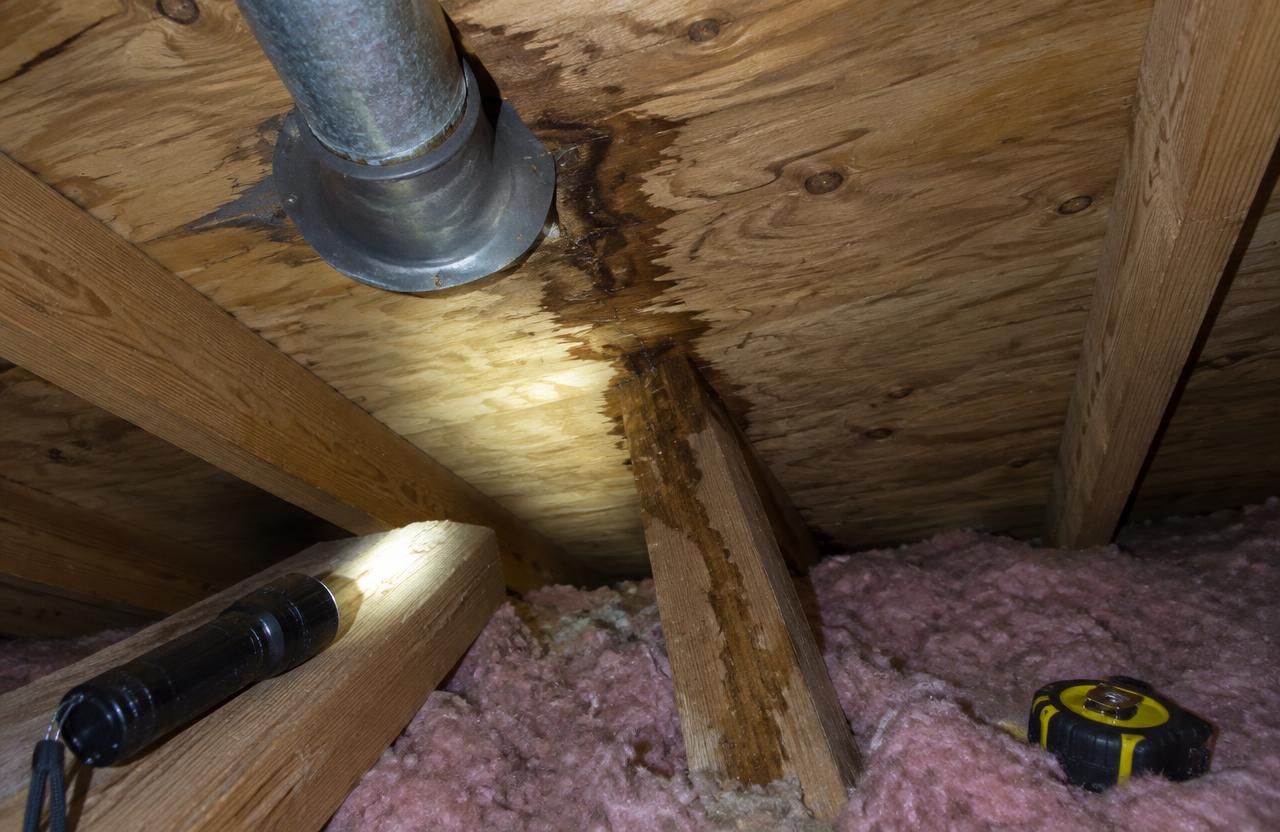
Water does not always drip straight down. It can soak into the roof boards. It can run along a rafter, which is one of the wood beams that hold up the roof. It can follow a pipe or a wire. So the drip in your ceiling may be away from the true opening. IKO, a shingle maker, also notes that damp air and plumbing leaks can look like a roof leak.
A careful roofer usually checks from both sides when it is safe. They look in the attic for wet wood, dark trails and rusty nails. Then they look at the roof above that area and higher up the slope. They may use a moisture meter, which is a small tool that reads dampness in wood.
Ask the roofer to show you photos of what they found. A good report points to one or more likely causes. It also says how sure they are, since some causes take a second look to prove. Common causes include the items below. The last two do not come from a hole in the roof.
- A cracked rubber boot around a plumbing vent pipe.
- Loose or rusted flashing, which is the metal that seals joints at chimneys and walls.
- Shingles lifted or torn off by wind.
- A worn spot in a valley, where two roof slopes meet.
- Nails that have backed out and poke up through shingles.
- Water backing up from a clogged gutter or an ice dam in winter.
- Not a roof hole: a bath fan or dryer vent that dumps damp air into the attic, where it can drip as frost melts.
- Not a roof hole: a leaking pipe in the ceiling or wall.
Step 4: Know Bellevue's published small-repair line
Bellevue's code has a clear rule for small roof repairs. We checked the online version on October 21, 2026. It showed supplement S-12. Here is what it says, in plain words.
Maintenance and repairs that add up to one roofing square or less do not need a permit. One roofing square is 100 square feet. But this only applies when the roof has one existing layer. The code does not say over what span of time repairs add up.
A separate line covers reroofing over 100 square feet. That work needs a permit, and the whole roof must then meet current code. The code does not say every repair past that size turns into a reroof or a full new roof. Where a bigger repair lands is a call for the building official.
These lines sit in the city's changes to the home building code. One of them says a roof recover is not allowed. A recover means putting new shingles over old ones. So on a Bellevue home, plan on not adding a new layer on top. Commercial roofs can follow other rules, so this page sticks to homes.
The online code warns it may not show the newest laws. Only the city can say how a rule fits your house. Use this to shape your questions, not as a free pass.
- Count all repair areas together, not one at a time.
- Ask the roofer how many layers your roof has now.
- If the total may pass 100 square feet, ask the city how the job is treated.
- If there are two or more layers, ask the city even for a small repair.
- Ask the roofer who will apply for a permit if one is needed.
Step 5: Find out who handles your address
Bellevue's building FAQ says the city covers its limits plus a two-mile area. A Bellevue mailing address does not settle it.
To find out, give the city your exact street address. The Permits & Inspections page links to the city's online permit system, called GovWell. It also lists the permit office on Wall Street. That is a city office. It is not our office, and you should not call it to reach a roofer.
Step 6: Read the repair scope before you say yes
A scope is the written list of work. It shows what you pay for and what is left out. The Federal Trade Commission tells people to get written estimates and to sign a written contract before work starts.
A good repair scope for a Bellevue home should answer these points.
- The likely leak source, with photos, or a plan to test more if it is not clear.
- The exact fix, such as a new pipe boot, new step flashing or new shingles.
- About how big the repair area is, in square feet.
- How many roof layers there are now.
- Whether a permit is needed, and who will get it.
- What happens if they find wet or soft wood.
- Whether any sealant is a temporary step.
- What warranty, if any, covers the labor.
- How they will clean up nails and old pieces.
When a repair stops making sense
A repair is a good choice when the rest of the roof is in fair shape. But some signs point toward a bigger job. Watch for these when you read the roofer's report.
- Leaks in many places at once.
- Shingles that curl, crack or have lost most of their grit all over the roof.
- A lot of soft deck wood found in more than one spot.
- A repair that would go well past one roofing square.
- Two or more layers, which may bring a permit and a full code review.
Storms, insurance and your records
If a storm caused the damage, call your insurance company soon. Ask them how they want you to report it. Ask if they want to inspect before a lasting repair. Do not wait to stop water from getting in, though. A tarp or temporary fix can limit damage. Keep the receipts.
Your roofer does not decide your claim. Only your insurance company does. If you have trouble with a claim, the Nebraska Department of Insurance has a page for filing a complaint.
Keep a simple folder for each repair. Put in the photos, the written scope, any change orders, the permit if there was one, and the final bill. These records help with later repairs, insurance and selling your home.
How we serve Bellevue for roof repair
We are serving Bellevue for leak repair. On this preview, the leak request form is off. It does not save or send what you type.
For now, get your notes ready. Tell the roofer where the stain is and when it shows up. Say if wind or snow melt makes it worse. A photo of the stain helps too.
Common questions
Is a small roof repair in Bellevue always permit-free?
No. The published code exempts repairs of one roofing square or less in total, and only on a roof with one existing layer. The online code can lag new laws. Ask the building official about your exact job.
What is a roofing square?
It is 100 square feet of roof, about ten feet by ten feet. The code adds repair work together but does not say over what span of time.
Why did the roofer find the leak far from my stain?
Water can run along boards, rafters and pipes before it drips. A stain can show up away from where the water got in. Some stains are not roof leaks at all, but damp air or a pipe.
Can the roofer just put sealant on it?
Sealant can be a short-term fix. Ask what the long-term fix is, how long the sealant may last, and if the bid says it is temporary.
My mailing address says Bellevue. Does the city handle my permit?
Not always. The city's FAQ says its area covers the city and a two-mile area around it. Give the city your exact address to find out who handles it.
Is the city permit office your office?
No. The Permits & Inspections office on Wall Street is a city office. It is not our office, and its phone number is not our line.
Related help
Sources we checked
Official and standards pages we used to check facts on this page. Rules can change, so confirm with the source.
- Bellevue, NE Municipal Code, sections 8-18.6 (published online text; may lag newer laws)
- City of Bellevue, NE: Permits & Inspections (government office, not our contact)
- City of Bellevue, NE: building FAQ (city limits and two-mile area)
- IKO (shingle maker): how to find roof leaks
- GAF (shingle maker): what is roof decking
- Federal Trade Commission: home repair scams (written estimates and contracts)
- Nebraska Department of Insurance: file an insurance complaint