Quick answer
A slate roof is a system with four main parts: the stone, the flashing, the layers under the stone, and the frame that holds it all up. When something goes wrong, the first job is to find which part failed. Single slates can often be repaired or replaced, and good old slates can sometimes be reused. Natural stone varies a lot, so not all slate lasts the same.
Slate is a system, not just stone
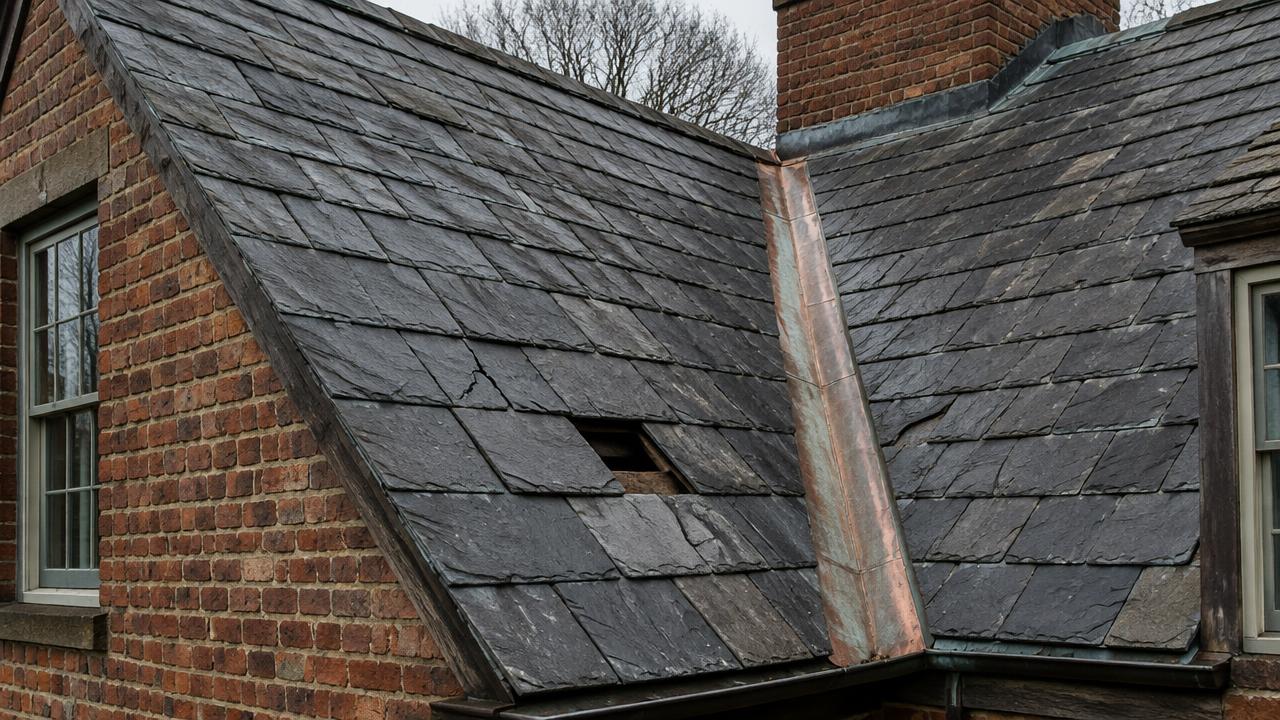
Slate is a natural stone split into thin pieces. A slate roof lays these pieces in overlapping rows, held with nails or hooks. But the stone is only one part. Flashing seals valleys, chimneys and walls. Layers under the stone, called underlayment, and the wood deck sit below. The house frame holds the weight of it all.
When a slate roof leaks, the cause may be in any of these parts. The National Park Service's guide to slate roofs explains that flashing and fasteners often fail before the stone does. So the first job is to find which part failed, not to assume the whole roof is done.
We serve homeowners across the Omaha area, including older homes that still have their slate. The drawing below shows the four parts in a simple way.
Natural stone varies
Not all slate is the same. Stone from different places and beds can be harder or softer. Some lasts a very long time. Some starts to flake, crumble or soften sooner. The National Slate Association's myths page notes that slate does not all last the same, and that a roof's life depends on the stone and how it was put on.
That is why a crew looks closely at your actual slates. They check for flaking, soft spots, and how the stone sounds when tapped. A roof with sound stone and worn flashing is a very different job from a roof where the stone itself is failing.
Repairing single slates
Many slate problems can be fixed one slate at a time. A crew removes the broken slate and its nails with a special tool. They slide in a new slate and hold it with a method that does not crack the slates around it. The Slate Association's repair page explains this kind of work.
The new slate should match in size, thickness, color and type as closely as possible. Some slate changes color as it weathers, so a perfect match can be hard. A crew may use salvaged slate from a hidden part of the roof or from another source.
Be careful with repairs that use roof cement or caulk smeared over slates. Those can trap water and make later repairs harder.
| Part | Common signs | Often the fix |
|---|---|---|
| The stone itself | Cracked, broken, flaking or missing slates | Replace single slates with a good match |
| Flashing (valleys, chimneys, walls) | Leaks near metal, rust, holes or loose pieces | Repair or replace the flashing, often keeping the slate |
| Fasteners | Slates sliding down because nails rusted | Reset slates with new fasteners |
| Underlayment and deck | Leaks with no clear stone or flashing cause, rot found | Larger work, often lifting and reusing sound slate |
| Structure | Sagging lines, or a frame never built for slate | Engineer review before any slate work |
Flashing on slate roofs
Flashing is the metal that seals the joints of a roof. On slate roofs, it is often copper or another long-lasting metal. Even so, flashing can wear, crack or come loose. Valleys carry a lot of water and wear first in many cases.
Fixing flashing often means lifting slates around it, then putting them back. A careful crew can often save and reuse those slates. Ask how they will remove and store slates during flashing work, and how many they expect to break.
Fasteners and sliding slates
Slates are held by nails. On older roofs, those nails can rust through. Then slates slide down and leave gaps. This is not the stone's fault. Many slates can be reset with new fasteners.
If many slates are sliding across the roof, that can point to widespread nail failure. In that case, a crew may suggest lifting and relaying sections with new nails, reusing the sound stone.
Underlayment and the deck
Under the slate is a layer of felt or another underlayment, and below that a wood deck. On many old slate roofs, the stone sheds most of the water, and the layers below are a backup. If the deck rots or the underlayment fails, leaks can show up with no clear stone or flashing cause.
Fixing these layers is bigger work. Slates must be lifted, the deck repaired, new underlayment put down, and the slates relaid. When the stone is sound, it can often be reused. Ask the crew how much stone they expect to save.
Structure: can the house hold slate?
Slate is heavy. A house built for slate was framed for that weight. A house built for a lighter roof may not be. Adding slate to a house that never had it can overload the frame.
Before choosing slate for a house that did not have it, have a structural engineer check the frame. The engineer can tell you if it can carry the weight or what changes are needed. We do not judge roof strength online.
Sagging lines on an existing slate roof are also a reason for an engineer to look. Our sagging roof page explains warning signs and what to do.
Repair, relay or replace?
A roof with sound stone and a few problems is often a repair job. A roof with sound stone but failing nails, flashing or underlayment may be a relay job: lift, fix the layers, and put the stone back. A roof where the stone itself is soft or flaking across the roof may need new slate or another material.
Ask the crew which of these fits, and why. Ask for photos of the stone, flashing and any deck problems. Get a second opinion on any plan to tear off a slate roof, since sound slate is hard to replace.
Who should work on slate
Slate work takes special tools and skill. Walking on slate can crack it. Crews use ladders hooked over the ridge, pads, and other methods to spread their weight. They follow fall protection rules for roof work.
Please stay off your slate roof. Look from the yard with binoculars, or ask the crew for close photos.
Keep a slate roof record
Keep a folder for your slate roof. Note the stone color and size if a crew can tell you. Add each repair, with photos and the date. Save a few spare slates in a dry spot if a crew leaves them. A good record helps the next crew match stone and see what was done before.
Matching new slate to old
Slate comes from many quarries. Each has its own color and texture. Some slate keeps its color for years. Some fades or turns a new shade as it weathers.
A good match looks at size, thickness, color and how the stone weathers. A crew may bring sample pieces to hold up next to your roof. Salvaged slate from old roofs can sometimes be a close match. Ask to see the match before they put it on.
Gutters and edges on slate homes
Old slate homes often have built-in or hanging gutters made of copper or other metal. Gutters can leak or pull loose. Water spilling from a gutter can rot the wood at the roof edge.
Fixing gutters on a slate roof may mean lifting the bottom rows of slate. A crew who knows slate can do this and save the stone. Ask how they will protect the slate during gutter work.
Signs you can spot from the ground
Use binoculars from the yard or the street. These are clues, not a diagnosis.
- Slates that are missing, leaving a dark gap.
- Slates that have slid down out of line.
- Light-colored edges where a slate has cracked or chipped.
- Pieces of slate on the ground or in the gutter.
- Green or rusty streaks near valleys and chimneys.
- Tar or caulk smeared on slates from old patches.
- A ridge or roof line that dips or waves.
Old patches that cause new problems
Many slate roofs carry years of quick fixes, like tar smeared on cracks or caulk along valleys. These can trap water, hide the real problem and make the next repair harder. Not every metal piece is a bad fix, though. The National Park Service guide on slate roofs describes a fitted metal bib, often copper, slipped under the joint above a replaced slate, or a slate hook, as proper repair methods. Ask which method the crew plans and why.
The Park Service guide warns against these quick patches on slate. A good crew may need to remove old patch material to see what is really going on. Ask them to show you photos before and after.
Ice, snow and slate
Omaha winters bring snow and ice. Snow can slide off slate in sheets. Some slate roofs have snow guards, small metal pieces that hold snow in place. They help protect gutters and people below. Snow guards should be fastened so they do not crack the slate.
Ice dams at the edge can push water up under slates. Our ice dam page explains safe steps. Never chip ice off a slate roof. It can crack the stone.
Historic homes
Many slate roofs are on older homes. Some are in historic districts. Changes to the roof may need approval from a local review board. Ask your city before you change the material or look of a historic roof.
The Park Service guide is written for historic buildings. It favors repair over replacement when the stone is sound. It also explains how to match new slate to old.
Questions to ask a slate crew
These questions help you compare plans.
- Which part failed: stone, flashing, fasteners, underlayment or structure?
- How do you know the stone is still sound?
- How will you match new slates?
- How will you remove and save slates during flashing work?
- Do you suggest an engineer check the frame?
- Will you send dated photos of the stone, metal and deck?
Common questions
Does a slate roof last forever?
No. Natural slate varies. Some stone lasts a very long time, and some wears out sooner. Flashing and fasteners often wear out before good stone does.
Can a few broken slates be fixed?
Often, yes. The National Slate Association explains that single slates can be replaced. The new slate should match in size, thickness and color as closely as possible.
Can old slates be reused?
Sound slates can sometimes be removed and reused, for example when flashing or the deck must be redone. A crew checks each one for cracks and soft spots first.
Can I put slate on a house that never had it?
Slate is heavy. A house built for a lighter roof may not hold it. Have a structural engineer check before you decide.
Should I walk on my slate roof?
No. Slate can crack under feet and is slick. Trained crews use special methods to work on slate without breaking it.
Related help
Sources we checked
Official and standards pages we used to check facts on this page. Rules can change, so confirm with the source.