Quick answer
Finding a leak on a flat roof is often harder than fixing it. Water can travel far under the membrane before it drips inside. Crews use several methods, like a close visual check, infrared scans, electronic testing and water tests. Each has limits. No method can promise to find the exact spot every time, so the best plans use more than one.
Why water travels before it drips
On a sloped roof, water usually runs downhill and drips near where it got in. On a flat roof, water can enter at a seam, soak into insulation and travel along the deck. It may drip inside many feet away, often at a low spot or a joint in the deck.
Ceilings, ducts and lights also hide the path. A drip over a desk may start near an air unit across the room. That is why a careful crew starts with clues, not guesses.
What you can do right away
If water is coming in, act first and plan the search second.
- Catch drips with buckets and move items out of the way.
- Keep people away from wet floors and from water near lights or outlets.
- If water is near electrical gear, keep clear and call an electrician.
- Take photos of the wet spots and note the time and weather.
- Call for help now. Do not wait days to see if it stops.
Clues that help a crew
Write down when the leak happens. Does it drip only in heavy rain, or in any rain? Only when wind blows from one side? Only when snow melts? Only when the air units run? Each answer points to different spots.
Mark every wet spot on a floor plan. Note the room, the ceiling tile and anything above it, like a duct or a beam. Share your roof log if you have one. Past repairs near the spot are a strong clue.
| Method | What it is good for | Limits to know |
|---|---|---|
| Close visual check | Open seams, cracked flashing, punctures, failed sealant | Cannot see under the membrane |
| Infrared scan | Mapping likely wet insulation over a large area | Shows temperature differences, not the entry point; needs the right weather |
| Electronic testing | Finding breaches in some membranes | Works only on certain roof builds and surfaces |
| Core cuts | Confirming what is wet and how the roof is built | Makes small holes that must be patched; samples only one spot |
| Water testing | Checking one suspect area at a time | Slow; can add water to the building |
Step one: a close visual check
Most leak searches start with a trained person walking the roof. They look above and uphill of the wet area. They check seams, laps, flashing, curbs, pipe collars, drains, edge metal and any recent work by other trades.
Many leaks are found this way. A split at a corner, a loose collar or a cut from a dropped tool can be clear once you know where to look. But some leaks hide under the surface, and that is when other methods help.
Infrared scans
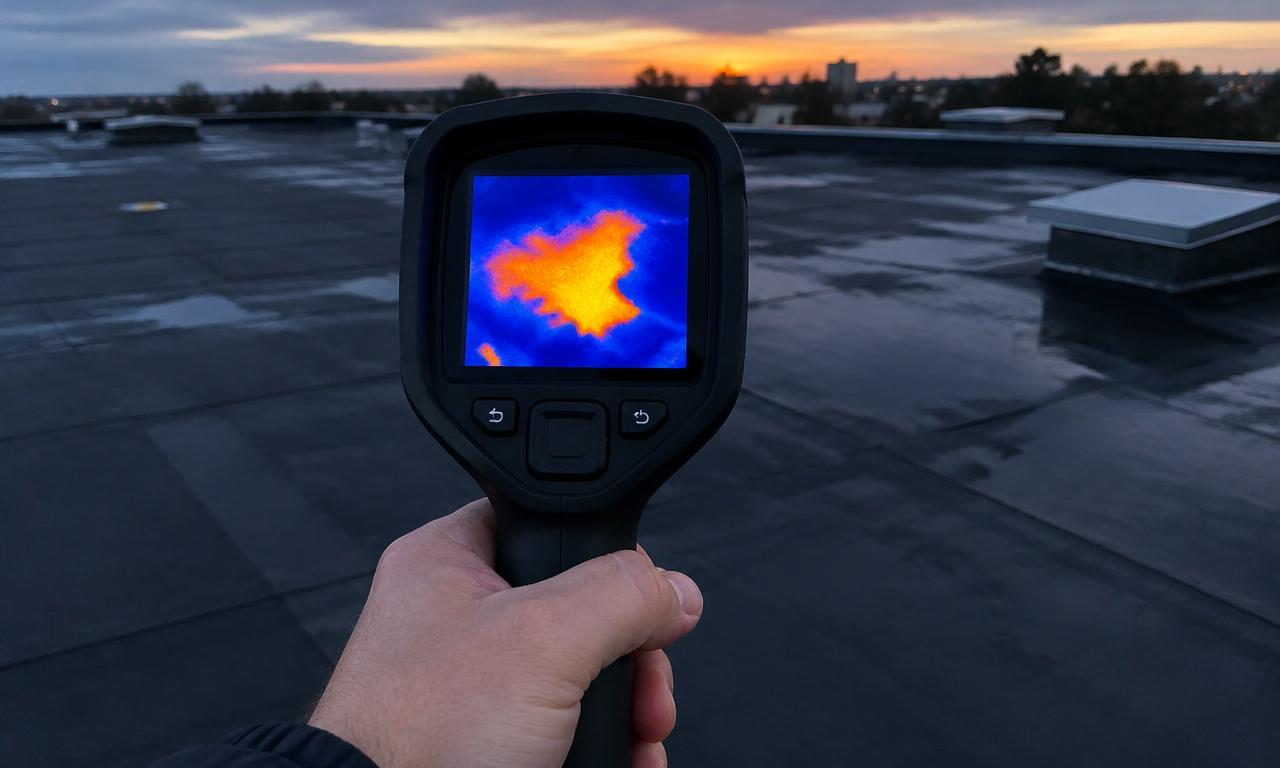
Wet insulation holds heat differently than dry insulation. After a sunny day, wet areas often stay warmer into the evening. A thermal camera can show those areas as a different color.
ASTM C1153 describes how to use infrared imaging to locate wet insulation in roofs. It also says this method does not find the cause of moisture or its point of entry. Weather matters too. Scans usually need a dry roof surface and the right temperature swing.
A scan gives a map of likely wet areas. Those areas are then checked with core cuts or moisture meters to confirm.
Electronic leak detection
Some methods use a small electric current to find breaks in a membrane. Water in a breach completes a path, and the tester can trace it to the spot.
ASTM D7877 describes these electronic methods. It notes they can be used on existing roofs for testing, with limits. It also says they are not meant to replace visual, infrared or other methods. They work best on certain roof builds, and some membranes or surfaces do not allow them. Ask the crew whether your roof is a good fit.
Core cuts and moisture meters
A core cut is a small sample cut through the roof layers. It shows how the roof is built and whether the insulation is wet. The hole is patched right away.
Moisture meters can test the surface or probe into the layers. They help outline wet areas. Both tools confirm what a scan suggests. Ask the crew to show you the cores and photos of each layer.
Water testing
A controlled spray test wets one small area at a time while someone watches inside. The crew starts low and moves up. This can show which detail lets water in.
A flood test is a different, bigger step. It holds standing water on part of the roof for a set time. Water is heavy, so the roof must first be checked to carry that added weight. The weather must suit the test, and the crew needs a planned, controlled way to drain the water after. Catching drips inside is not enough. Coating maker guides, like Sika's, list flood testing as a step with its own rules.
Water tests are slow and add water to the building, so they are used with care. They should be done by the crew, with someone inside ready to catch drips and stop the test.
Leaks that are not from the roof
Not every drip is a roof leak. Air units can leak condensate. Pipes and sprinkler lines can drip. Moist air can condense on cold ducts or the underside of a cold deck. Walls and windows above a roof can let water in that runs down behind flashing.
A good search keeps these in mind. If the leak shows up when it is not raining, tell the crew. That one fact can save a lot of time.
What a good leak report includes
Ask for a written report, even for a small job.
- Where the water showed up inside.
- What methods were used and what each one showed.
- The likely entry point, and how sure the crew is.
- Photos of the spot before and after any fix.
- Any wet insulation found and how big the area is.
- Other weak spots worth fixing soon.
Wet insulation after the leak is fixed
Fixing the hole does not dry the insulation under it. Wet insulation can lose some of its ability to slow heat, depending on the type. It can also add weight and harm the deck over time.
Ask how much area is wet and what the crew suggests. Small wet areas are often cut out and replaced. Large ones may change the plan for repair, coating or replacement. Coatings and new layers should not go over wet insulation.
When the leak keeps coming back
If a leak returns after a repair, the first fix may have been at the wrong spot, or there may be more than one entry point. Do not keep paying for the same patch.
Ask for a fuller search with more than one method. Share all past reports and photos. A crew that sees the full history has a better chance of finding the real cause.
Safety during a search
Leak searches often happen in wet or dim conditions. Roofs can be slick, and infrared scans may run after dark. OSHA's fall protection rule applies to work near unprotected roof edges. A crew needs a plan for edges, skylights and openings.
Inside, wet ceilings can sag and fall. Keep people out from under any ceiling that bulges or holds water.
Questions to ask before you hire
Ask which methods they use and why they chose them for your roof. Ask what each one can and cannot show. Ask how they price the search versus the repair.
Be careful with anyone who promises to find every leak or names the cause before going on the roof. Honest crews explain their limits.
Leaks during winter and thaw
Some leaks show up only when snow melts. Melt water can sit against edges and curbs longer than rain does. Ice can also block drains and push water into places it normally would not reach.
If your leak shows up during thaws, tell the crew. They may look at drains, edge metal, walls and low areas first. Some methods, like infrared, may need to wait for the right weather.
How long a search may take
A simple leak may be found in one visit. A hard one may take several visits and more than one method. Weather can also slow things down.
Ask the crew how they plan to work, how they will bill for the search and when they will check back. A clear plan keeps everyone on the same page.
Keeping records for next time
Once a leak is found and fixed, add it to your roof log. Note the date, the spot, the method that found it and the fix. Add photos.
If water shows up near the same place later, that record saves time. It also helps if a warranty claim is needed, since many warranties ask for proof of prompt reporting and repair.
Warranty and leak calls
If your roof is under warranty, call the maker or the installer named in it before anyone else makes repairs. Some warranties can be voided by work from an unapproved crew.
Keep copies of every leak report. Note when you called and who you spoke with. Ask the crew to follow the maker's repair rules.
Inside clues worth a photo
Some signs inside the building help a crew narrow the search. Take a photo of each one and mark it on a floor plan.
Look for stained ceiling tiles, rust on steel deck or beams, drips along ducts or light fixtures and damp spots on walls near the roof line. Note any smell of must or mold. Do not climb ladders into ceiling spaces to look. Leave that to the crew.
How our request form works
We serve homes and businesses across the Omaha area. This website is a preview right now. The online form checks your answers, but it does not save or send them yet, so no roofer gets your request from it.
When online requests are turned on, this note will change. Until then, the form is a way to see what we will ask: your town or ZIP, what you see and what kind of help you need. We do not sell your details.
Common questions
Can you guarantee you will find my leak?
No honest crew can promise that. Water can move a long way under a roof. Good crews use more than one method, explain what they found and tell you how sure they are.
Is an infrared scan enough by itself?
Usually not. ASTM C1153 says an infrared survey locates likely wet insulation but does not find the cause or entry point. Crews often confirm with core cuts and a close look at nearby seams and openings.
What is electronic leak detection?
It uses a small electric current to find breaks in some membranes. ASTM D7877 describes these methods and says they should be used along with other inspection methods, not instead of them.
Why does the leak inside not line up with damage on top?
Water can enter at one spot, run along the deck or between layers and drip out somewhere else. That is why the drip inside is a clue, not a map.
What should I do while I wait?
Catch the water, move items, protect floors and keep people clear of wet areas. Call for help right away. The EPA says wet materials should be dried quickly to help prevent mold.
Related help
Sources we checked
Official and standards pages we used to check facts on this page. Rules can change, so confirm with the source.
- ASTM D7877: electronic leak detection for waterproof membranes, D7877-24 (summary)
- ASTM C1153: locating wet roof insulation with infrared imaging (summary)
- Sika: Sikalastic RoofPro product data, including flood test guidance (PDF)
- U.S. EPA: a brief guide to mold, moisture and your home
- OSHA: fall protection rule for construction, 29 CFR 1926.501