Quick answer
Wet insulation is water trapped under a flat roof's top sheet. You often can't see it from above. It can cut how well the insulation works, add weight and lead to more damage. Finding it takes testing on the roof, and every test method has limits. No one can tell if your roof insulation is wet just from a photo.
What wet roof insulation is
Many flat commercial roofs have boards of insulation between the deck and the top sheet. The insulation helps keep heat in during winter and out in summer. Common types include foam boards and fiber boards. The top sheet keeps water out of the insulation.
When water gets past the top sheet, it can soak into the boards. It may spread a long way before it ever drips inside. Sometimes it never drips at all. The roof may look fine from above while large areas below are wet.
We serve building owners across the Omaha area. Wet insulation is one of the main things we look for before any repair, coating or recover plan.
Why wet insulation matters
Wet insulation does not insulate as well. The Department of Energy explains that insulation works by slowing the flow of heat. Water in the boards can make that job harder. That may raise heating and cooling costs, though how much depends on the roof.
Water also adds weight to the roof. It can rust metal decks and rot wood decks over time. Some boards can crush when wet, making low spots where more water sits. And wet layers can make a coating or recover fail early, since the water is trapped under them.
Signs that may point to wet insulation
These are clues, not proof. Only testing can confirm wet insulation.
- Spots that feel soft or spongy when a trained crew walks on them.
- Blisters or bubbles in the top sheet.
- Water that squirts out when a spot is pressed.
- Old leaks that were patched many times in the same area.
- Low spots that were not there before.
- Stains or rust on the deck when seen from inside.
| Method | How it works | Limits |
|---|---|---|
| Infrared scan | A heat camera shows spots that hold heat differently, often at night after a sunny day | Needs the right weather; some roofs and gravel make readings hard; spots must be confirmed |
| Moisture meter (impedance) | A meter reads changes in the roof as it rolls or sits on it | Reads only so deep; some roof types confuse it; needs confirmation |
| Nuclear meter | A trained tech measures hydrogen in the roof on a grid | Needs special license and training; also needs confirmation |
| Core cuts | A small piece is cut out to see and feel the layers | Only shows that one spot; each cut must be patched right away |
| Electronic leak testing | Finds holes in the top sheet on some roof types | Finds breaches, not how much insulation is wet |
Infrared scans
An infrared scan uses a heat camera. After a sunny day, the roof warms up. At night, dry areas cool off faster. Wet areas hold heat longer and show up as warmer spots on the camera. ASTM C1153 is a standard for this kind of scan.
Infrared needs the right weather. A sunny day, a clear night, and a dry roof surface all help. Wind, clouds, gravel and some roof types can make readings hard. Warm spots can also come from things that are not water. So scan results should be checked with core cuts.
Moisture meters and nuclear meters
An impedance meter reads changes in the roof as it sits on or rolls across the surface. Wet areas read differently from dry ones. ASTM D7954 is a standard for these surveys. These meters only read so deep, and some roof types can give false readings.
A nuclear meter counts hydrogen in the roof. Water has lots of hydrogen. Techs take readings on a grid and map the high spots. This method needs special training and a license. Like other methods, its results are confirmed with core cuts.
Core cuts: seeing what is there
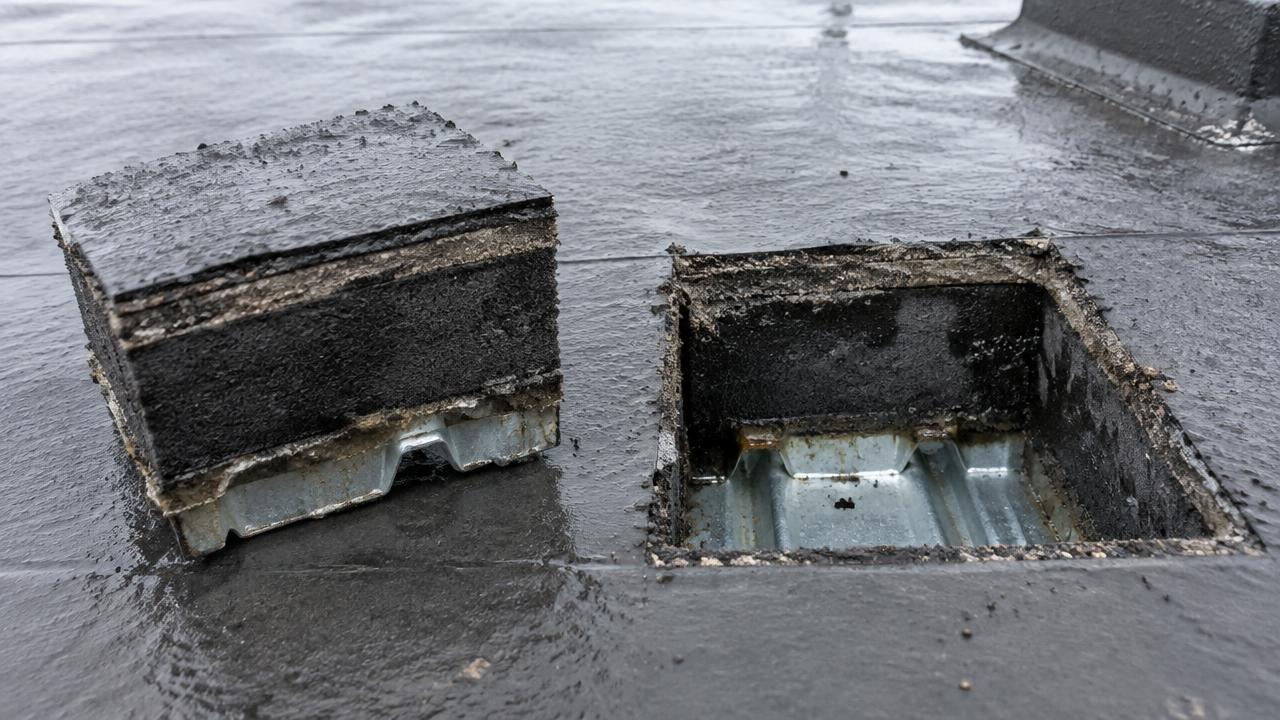
A core cut is a small piece cut out of the roof, down to the deck. The crew can see each layer and feel if it is wet. They can count layers and see what type of insulation is there. They can check the deck too.
Cores show only one spot. That is why they are often taken where scans or meters point, plus a few dry spots to compare. Each core hole must be patched right away with parts made for that roof. A good report includes a photo of each core and a map of where it was taken.
Leak testing is a different job
Electronic leak testing finds holes in the top sheet on some roof types. ASTM D7877 covers it. It can help find where water got in. But it does not tell you how much insulation is wet.
So a crew may use more than one method. One finds the holes. Another maps the wet area. Cores confirm both. Our leak detection page explains these tools in more detail.
Why no one should diagnose from a photo
We get asked to look at roof photos often. Photos help us plan a visit. But wet insulation is usually hidden. A photo can't show what is under the sheet. Even a heat camera photo needs the right weather, the right setup and confirmation by cores.
Be careful with anyone who says your insulation is fully wet, or fully dry, from a photo alone. Ask what method they used, when, and how they confirmed it.
What happens after wet areas are found
Once wet areas are mapped, the crew can plan. Small wet areas may be cut out and replaced with dry boards, then the top sheet is patched. Large wet areas may mean a full tear-off is the better choice.
If you are thinking about a coating or a recover, dry insulation is usually a must first. Coating makers and recover rules often call for wet areas to be removed. Ask for a plan that shows which areas will be replaced and how they will be measured.
Plan a recheck after repairs
After wet areas are replaced and leaks are fixed, a follow-up check can confirm the work held. Some owners plan a scan a year later, under the same kind of weather, to compare with the first one. New warm spots near old repairs can show a leak was missed or came back. Keep both reports side by side in your roof log.
Wet insulation and roof weight
Water is heavy. A wet roof area carries more weight than a dry one, and it stays heavy until the water is removed. That adds to snow and rain loads in winter and spring. FEMA's snow guidance points out that extra water on roofs adds load.
We do not judge whether a roof can carry that weight. If a large area is wet, or you see sag inside, ask a structural engineer. Removing wet boards during repair also takes that extra weight off the roof.
How water gets into roof insulation
Water can reach insulation in several ways. Open seams, cracked flashing and holes from dropped tools are common. Leaks at drains and penetrations can soak large areas. Water can also be trapped during install if boards got wet before the roof was finished.
Inside air can be a cause too. Warm, humid air from a pool, kitchen or plant can rise into the roof. If it reaches a cold layer, it can condense into water. Two different parts help. A vapor retarder slows water vapor as it moves through materials. That is called diffusion. An air barrier stops moist air from leaking up through gaps. One layer can sometimes do both jobs, but they are not the same thing. A design pro decides what a roof needs.
Timing and weather for a survey
Each method works best at certain times. Infrared often needs a sunny day followed by a clear, calm night. Impedance meters need a dry roof surface. Standing water, snow or frost can block most methods.
In Omaha, that can mean waiting for the right day. Ask the crew when they plan to test and why. If the weather is not right, a careful crew may reschedule rather than give weak results.
Different insulation types act differently
Some boards soak up water like a sponge. Others resist water better but can still trap it between layers. Some fiber boards lose strength when wet and may crush. Foam boards may hold water at their edges and seams.
That is one reason cores matter. They show what type of board is there and how it looks when wet. The repair plan can then use the right replacement boards. Mixing types can change how the roof performs, so ask what will be used.
How big are the wet areas?
Surveys usually mark wet areas on a roof plan. The size of each area helps decide the repair. A few small spots may be cut out. Wet areas spread across much of the roof may point to a full replacement.
Ask the report to give rough square footage for each wet area and for the whole roof. Ask how the edges were found. This helps you compare bids, since each crew should be pricing the same areas.
Inside clues and safety
From inside the building, you may see stains, rust on the deck, or drips at deck seams. Ceiling tiles may sag or show brown rings. These clues help a crew know where to start, but they don't show how far the water spread.
If ceilings sag with water, keep people away. If you see signs a roof could fall in, like a sagging ceiling, new cracks or doors that suddenly stick, leave the building and call 911 from outside. Do not climb up to look at wet areas or touch wet electrical gear.
What a good moisture survey report includes
A clear report helps you decide, and helps the next crew.
- The method used, the date, and the weather at the time.
- A roof plan with wet areas marked and their rough size.
- Core locations, with a photo and notes on each.
- What insulation and deck were found.
- Any leak sources found.
- Options: spot replacement, larger repair, or replacement.
Common questions
Can you tell from my photos if the insulation is wet?
No. Wet insulation is usually hidden under the top sheet. A photo might show a stain or a soft-looking area, but only testing on the roof and core cuts can confirm it.
Does wet insulation always mean a new roof?
Not always. If only small areas are wet, a crew may cut those out and replace them. If large areas are wet, a full tear-off may be needed. A moisture survey helps decide.
Can we coat or recover over wet insulation?
Coating makers and recover rules generally call for dry insulation first. Wet areas are usually removed and replaced before any coating or recover.
Will wet insulation dry out on its own?
Insulation sealed under a roof sheet often stays wet for a long time. Some may dry a little, but it is not something to count on.
Does wet insulation cause mold?
Wet building materials can grow mold. The EPA says to fix water problems and dry materials fast. A crew can tell you if any wet areas reach the inside.
Related help
Sources we checked
Official and standards pages we used to check facts on this page. Rules can change, so confirm with the source.
- ASTM C1153: locating wet roof insulation with infrared imaging (summary)
- ASTM D7954: moisture surveys of roofs with impedance meters (summary)
- ASTM D7877: electronic leak detection for waterproof membranes, D7877-24 (summary)
- U.S. DOE Building America: understanding vapor barriers (PDF)
- U.S. Department of Energy: insulation basics
- U.S. EPA: a brief guide to mold, moisture and your home