Quick answer
Wind pulls up on a roof, and the pull is often strongest at the edges and corners. A roof resists that pull through a connected chain of parts, from the cover down to the frame. Ratings apply only to the exact tested assembly installed as tested. A building-specific engineer or roof designer should set the design. No roof is windproof.
How wind pulls on a roof
When wind blows over a building, it speeds up across the roof. That creates suction. The roof is pulled up, not just pushed. Air leaking up from inside can add to that lift.
The pull is not even. It is often strongest at the edges and corners, where the wind swirls. The middle of the roof often sees less. That is why design standards treat these zones differently.
The load path: a chain of parts
A roof holds down through a chain. The cover is fastened or glued to the insulation or deck. The deck is fastened to the frame. The frame is tied down through walls and columns to the foundation.
A chain is only as strong as its weakest link. A strong membrane does not help if the deck lifts off the frame. Strong framing does not help if edge metal peels back. Each link must be designed and built to carry the pull.
Why edges fail first
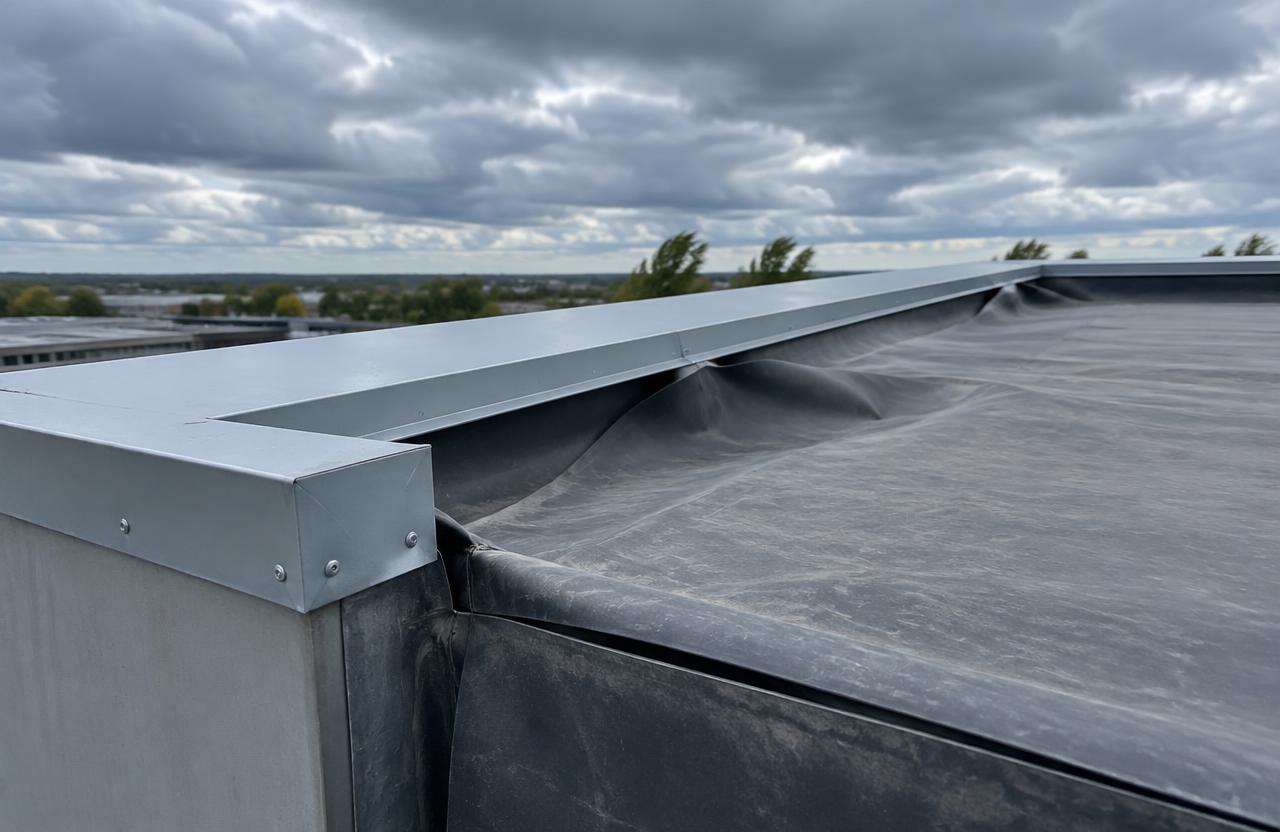
Many roof wind failures start at the edge. Once wind gets under edge metal or a coping, it can peel the membrane back like a sticker. The damage can then spread across the roof.
That is why edge metal matters so much. Groups like SPRI publish tested edge details. Ask your designer which edge system is planned and how it was tested. Ask how it will be fastened.
| Part of the chain | What can go wrong | Who decides the fix |
|---|---|---|
| Edge metal and copings | Loose or under-fastened edges let wind get under the roof | Roof designer using tested edge details |
| Membrane and seams | Seams or attachment let go and the sheet billows | Roof designer and membrane maker |
| Insulation attachment | Boards lift if fasteners or adhesive are not as tested | Roof designer per the listed assembly |
| Deck attachment | Deck lifts off the frame | Structural engineer |
| Frame to foundation | Loads not carried down to the ground | Structural engineer |
What a tested assembly means
Labs test whole roof assemblies, not just one part. A test sample includes a set deck, insulation, fasteners or adhesive, cover board and membrane, put together a certain way. The rating applies to that build.
FM Approvals, for example, gives ratings like Class 1-90. The 90 is a pressure class from the test. It is not 90 miles per hour. Change the deck, the fastener spacing or the adhesive, and the rating may no longer apply.
Ask which listed assembly your design follows. Ask to see the listing. Then ask how the crew will match it in the field.
Who should design for wind
Wind design depends on many things. Location, building height, shape, openings, roof type and use all play a part. Current codes and standards set the method. Your insurer may have its own rules too.
A building-specific engineer or roof designer should do this work. They work out the pressures for each roof zone. They then choose an assembly and details that meet them. We do not post wind speeds, pressures or fastener patterns here, because they must be worked out for each building.
Metal roofs and wind
Metal roofs resist wind through clips, fasteners and framing. Clip type and spacing come from tested data. The Metal Construction Association explains how attachment design matters.
On a metal roof, look at the edges, rakes and ridges. These spots often get extra clips or fasteners in the design. Do not assume more screws are always better. The tested design sets what is right.
Signs worth a closer look
From the ground or a safe window, you may see clues. Edge metal that looks bent or loose. A membrane that billows on windy days. Loose pieces in the yard after a storm. Water stains near outer walls inside.
Do not go up to look. Wind can knock people off a roof. A loose sheet can also give way underfoot. Take photos from a safe spot. Then ask a qualified crew to inspect the edges, corners and seams.
After a wind event
If a storm has hit, keep people away from the building's edges where debris may fall. Do not climb up during or right after the storm. Wait until winds die down and it is safe for trained workers.
A crew should check edges, corners, seams and fasteners. Temporary steps may keep water out until a full repair. They are not the final fix. Our commercial emergency page covers safe first steps.
History is not today's numbers
Old loss studies show that wind damage often starts at the edges and roof attachment. They help explain why standards changed. But old numbers do not tell you the current risk for your building. Use current standards and a designer's review instead.
Inside air pressure matters too
Wind does not only pull from above. If a big door or window breaks open in a storm, air rushes in. That pushes up on the roof from below while wind pulls from above. The two can add up.
Designers consider this when they set loads. Openings and how tight the building is matter. Keeping doors and windows strong and closed in storms can help.
Fastened, glued and weighted roofs
Roofs hold down in a few main ways. Mechanically fastened roofs use screws and plates. Adhered roofs use glue or adhesive. Ballasted roofs use stone or pavers to weigh the sheet down.
Each method has its own design rules. Fastener spacing, adhesive coverage and ballast size come from tested data and standards. A repair should match the method and design already in place.
Rooftop units and gear
Units, vents and solar panels on the roof also face wind. If they are not tied down well, they can shift or blow off. They can then tear the roof and let water in.
Ask how gear is attached. The roof designer, mechanical trade and engineer may all have a part. A good plan ties gear to the structure, not just to the roof sheet.
Older roofs and changes over time
An older roof may have been built to older rules. Over time, fasteners can rust, adhesive can weaken and edge metal can loosen. Repairs may have changed the original build.
A wind check on an older roof looks at what is there now. A crew might do pull tests on fasteners or check edges closely. The results help decide if repair or upgrade is needed.
Insurance and wind
Some insurers have rules for roof wind ratings. They may ask for a certain rating or edge detail. Ask your insurer early, before you choose a design.
Keep records of the design, the listed assembly and photos of the edges during install. These help with renewals and claims.
Roof zones: field, perimeter and corners
Designers split a roof into zones. The middle is often called the field. The band along the edges is the perimeter. The corners are their own zone. Each zone can have its own design load.
The size of each zone depends on the building and the standard used. Attachment is often heavier in the perimeter and corners than in the field. When a crew repairs or replaces part of a roof, the repair should match the zone it is in.
Edge metal and copings in detail
Edge metal wraps the roof edge. Copings cap the top of parapet walls. Both hold the membrane edge in place and keep wind out. Their size, fastening and cleats matter a lot.
Tested edge systems have set fastener types and spacing. SPRI and others publish standards for testing edge systems. Ask if your edge metal is a tested system and how it will be attached.
Pull tests and field checks
On some jobs, crews test how well fasteners hold in the deck. This is called a pull test. It helps show if the deck can hold the fasteners the design calls for. Weak results may change the plan. Ask if pull tests are part of your job and what the results mean.
Wind damage and a full roof check
Wind damage is not always easy to see. A sheet may have pulled at a few fasteners but laid back down. Seams may have stretched. Insulation boards may have loosened under the sheet.
After a big wind, a trained crew can check edges, seams and fasteners closely. They may look for loose boards by feel or test. Ask for photos and notes of what they find.
Temporary fixes after wind
After wind damage, a crew may need to secure loose edges or sheets before a full repair. These steps can slow water and stop more peeling. They are temporary.
A temporary fix may not meet the tested design. Plan a full repair that does. Ask the crew to note in writing what is temporary.
Wind design during a reroof
A reroof is a good time to check wind design. Current standards may ask for more than the old roof had. The designer can update edges, attachment and zones to meet them. Ask if your new roof design follows the current rules and which tested assembly it uses.
Questions to ask your designer
Bring these to a meeting with your roof designer or engineer.
- What wind pressures did you calculate for each roof zone?
- Which tested assembly meets those pressures?
- What edge metal system is planned, and how was it tested?
- How will the deck be tied to the frame?
- How will the crew match the tested assembly in the field?
- What does my insurer require, if anything?
Common questions
Does a 1-90 rating mean the roof survives 90 mph winds?
No. In FM Approvals classes, a number like 90 is a pressure class from a lab test. It is not a wind speed. A designer works out the pressure your building needs, then picks an assembly rated for it.
Why are edges and corners so important?
Wind often pulls hardest at edges and corners. Many roof failures start there. Design standards call for stronger attachment in those zones. The exact amount depends on the building.
Can a crew just add more screws?
Not as a general fix. The right fasteners, plates, spacing and adhesive come from the tested assembly and the design. Adding random screws can tear sheets or void a rating.
What wind speed should my roof be built for?
That depends on the location, building height, shape, use and current code. We do not state it here. A designer finds the right value for your building from current standards.
Is any roof windproof?
No. A well-designed roof resists the loads it was designed for. Stronger storms or flying debris can still cause damage.
Related help
Sources we checked
Official and standards pages we used to check facts on this page. Rules can change, so confirm with the source.