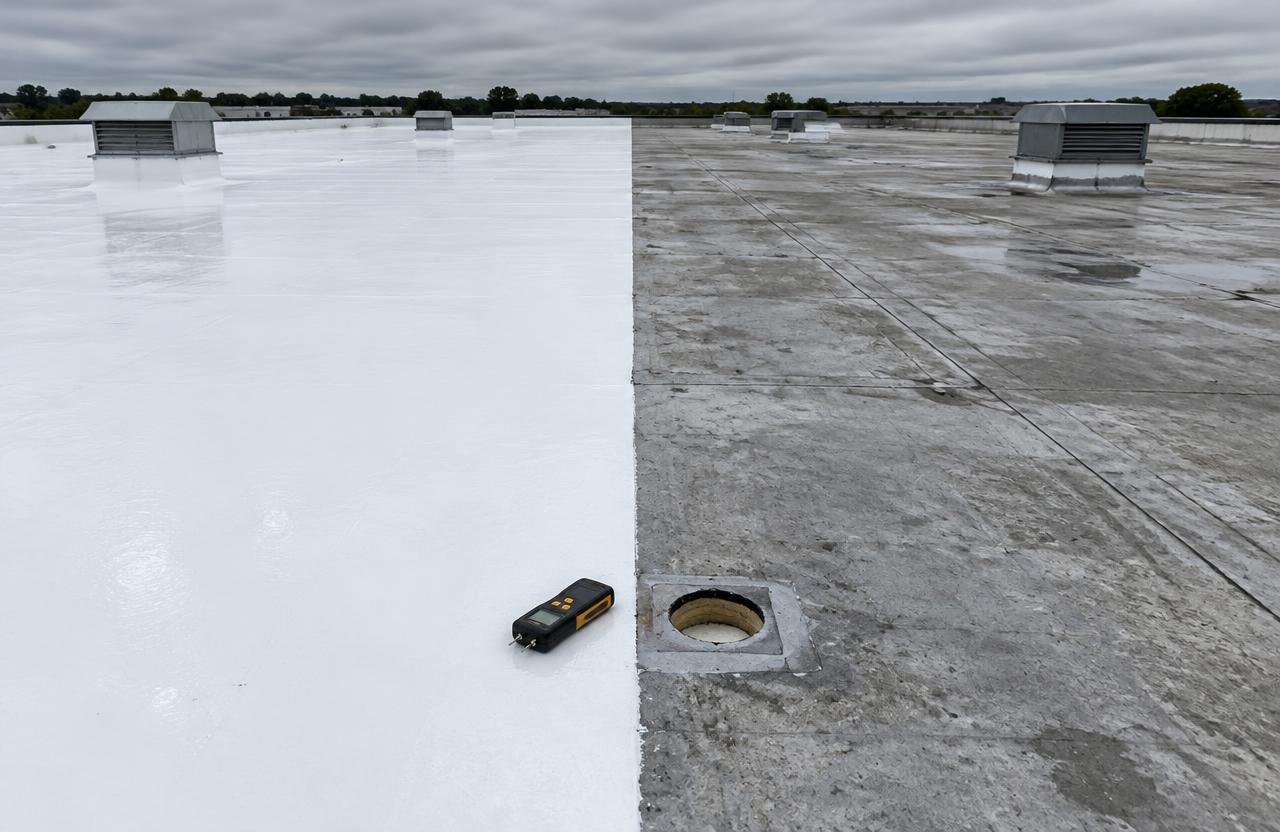
Quick answer
Whether to coat or replace a low-slope roof depends on its condition, moisture, structure, drainage, how well a coating will stick and whether the maker allows it. Wet or damaged materials must be dealt with first. There is no single moisture number, promised extra life or weather window that fits every product. Coating asphalt shingles is not the same as restoring a commercial roof. The exact product's rules decide what is possible.
Two different jobs
A coating adds a liquid layer over a roof that is still sound. Replacement removes the old roof and builds a new one. They solve different problems.
A coating can help a roof that is in fair shape but aging. It can't fix a roof that is wet, falling apart or badly drained. GAF's guide on coating versus replacement says the roof's condition decides which fits.
Start with structure
Before anything else, the roof structure needs to be sound. Sagging, bent decks or signs of overload are serious.
If you see sagging, keep people off and away from the area below. Get a qualified structural review. No coating fixes a structural problem.
Find out what is wet
Water can hide under a roof for years. Wet insulation is heavy, insulates poorly and can harm the deck. Coating over it traps the water.
A moisture survey maps where layers may be wet. Core cuts confirm what's there. All wet or damaged areas must be removed and replaced before any coating. There's no single moisture percentage that works for every roof and product.
| Question | If yes | If no |
|---|---|---|
| Is the structure sound? | Go to the next question | Get a structural review first |
| Have all wet or damaged areas been removed and replaced, and the rest confirmed dry and sound? | Go to the next question | Stop: remove and replace them first, or plan replacement |
| Does water drain off well enough for the product? | Go to the next question | Fix drainage or pick a product approved for it |
| Does a test patch stick well? | Go to the next question | Change prep or primer, or rule out coating |
| Does the maker approve this product over this roof? | Coating may fit | Coating does not fit as planned |
How much is wet matters
If only a few areas are wet, every one of them must be removed and replaced first. Only then, with the rest confirmed dry and sound, can coating be weighed. GAF's liquid-applied manual sets this as a basic rule. If much of the roof is wet, replacement may make more sense.
Ask for a map of wet areas and their size. That helps you compare the cost of spot replacement plus coating against full replacement.
Drainage
Many coatings don't like long-standing water. Some products are made to handle ponding better, but only as their maker says.
Look at where water sits after rain. Fixing drains or adding slope may come first. Pick a product whose maker approves it for your drainage.
Adhesion: will it stick?
A coating only works if it sticks. Dirt, chalk, old coatings and some membranes can stop it from bonding.
A test patch, often called an adhesion test, shows how well it sticks after prep. GAF's liquid-applied roofing manual explains prep, primers and testing. Ask for results in writing.
Chemistry has to match
Not every coating works over every roof or every older coating. Silicone, acrylic and other types each have rules about what they go over and what can go over them later.
There's no universal match. Ask which maker's guide approves this product over your exact roof.
Repairs come first
Before coating, damaged seams, flashings, curbs and drains usually need repair. Open seams or loose flashing won't be fixed by a coating alone.
Ask what repairs each bid includes. Ask how they'll be done and with what materials. The coating maker may set rules for these too.
Silicone over acrylic: a narrow case
GAF's technical note C-47 allows its silicone over its own listed acrylic in spots with poor drainage. The silicone must go on within 90 days of the first acrylic coat, before the final check. All the note's other rules apply.
This is part of a new job. It isn't a way to save an old or peeling acrylic roof. Failed coating needs to come off or get the prep the new product's maker requires.
Shingles are a different case
You may see ads for coating asphalt shingle roofs. That's not the same as restoring a low-slope commercial roof.
Shingle roofs shed water differently. A coating can change how they work and may affect the shingle warranty. Ask the shingle maker before you do it.
Weather and cure
Each coating has limits for temperature, humidity, dew and rain before it cures. These vary by product.
Follow the exact product's data sheet. A crew should wait if conditions aren't right. Rushing can lead to poor bonds.
Thickness and coverage
Coatings need a certain thickness to work. Seams and details often need more, or fabric.
Ask how thickness will be checked. Ask for the maker's spec. Too thin a coat can wear through early.
What a coating can't promise
We don't promise a set number of extra years. Results depend on the roof, product, thickness, drainage and care.
Ask what the maker's warranty covers, for how long and with what upkeep. Read the exclusions.
When replacement makes more sense
Replacement often makes more sense when much of the roof is wet, the membrane is failing widely, drainage needs major work or the deck needs repair.
It also gives a chance to add insulation, fix slope and choose a new system. Our commercial roof cost guide explains how to compare those bids.
Compare bids on the same facts
Give each bidder the same moisture survey and core results. Ask them to price spot repairs, coating and replacement separately.
Then compare what each path includes. A cheaper coating bid that skips wet area removal isn't a fair comparison.
Upkeep after either choice
Both coated and new roofs need regular checks. Keep drains clear. Look at seams, edges and openings.
Some coating warranties require inspections or recoating at set times. Put those dates on a calendar.
Questions to ask each bidder
What did the moisture survey and cores show? How much wet material will you remove? How will drainage be handled? What did the adhesion test show?
Which product and maker's guide are you following? What repairs are included? What warranty comes with it, and what upkeep does it need?
What a moisture survey does and doesn't show
A moisture survey uses tools like infrared cameras or meters. It points to spots that may be wet under the top layer. It is a map of likely wet areas, not proof.
Core cuts check what is really there. A crew cuts a small sample and looks at the layers. Then they patch the hole. Ask how many cores were cut and where.
Seams, flashings and drains
Most leaks start at seams, edges, curbs and drains. These spots need the most care before any coating.
Many coating makers call for fabric or extra coats at these spots. Ask how each one will be handled. A coating over an open seam can still leak.
Metal roofs and coatings
Some coatings are made for metal roofs. Rust, loose screws and open seams must be dealt with first. The maker's guide says how.
Our metal restoration page goes into this in more depth. The same rule holds: the product's maker decides what is allowed.
Weight and layers
Each layer adds weight. Wet insulation adds a lot. A coating itself adds little, but old wet layers left in place do.
If the roof already has more than one layer, ask how that affects the plan. Local rules may limit how many layers a roof can have.
Warranties on coated roofs
Coating makers may offer warranties tied to thickness, prep and inspection. Terms vary a lot by product and installer.
Ask what the warranty covers. Does it cover leaks or only the coating peeling? How long? What upkeep does it need? Get the paper, not a summary.
Talking it through with your team
Owners, managers and finance people may each have a say. Some care most about cost now. Others care about cost over many years.
Share the survey, the test results and the bids. Show what each path includes. That helps everyone see why one path fits better.
Signs a roof may be past coating
Some signs point toward a bigger job. Wide areas of wet insulation. A sheet that is cracked, brittle or shrinking all over. Many leaks in many places. A deck that feels soft or bends.
These signs don't decide it alone. But they are good reasons to ask for a full look and a replacement price, too. Then compare the two paths side by side.
Safety while you check
Don't walk on a roof you think may be weak or wet. Don't go near open edges or skylights. Leave roof checks to trained people with fall protection.
From inside, look for stains, drips and sagging ceilings. If a ceiling sags, keep people out of the area and call for help.
A simple way to compare the two paths
Make two columns. In one, list what the coating path needs: wet area removal, repairs, drain work, prep, the coating and its upkeep. In the other, list what the new roof path needs: tear-off, deck repairs, new layers, drains and its upkeep.
Put a bid price next to each line. Add a note for what each path leaves out. Now you can see the full picture, not just the first price. This also helps when you talk to owners or a board.
Keep records either way
Save the survey, the core results, the test patch notes and the final papers. Add photos of the roof before and after.
If you coat now, these records help when it is time to recoat or replace later. The next crew will know what is under the top layer.
How we serve owners weighing coating or replacement
We are serving building owners across the Omaha area. Use the form on this page to ask for a roof check and a written comparison.
We will base our advice on what the roof shows, not on one preferred answer.
Common questions
How wet is too wet to coat?
There's no single number for every roof. All wet or damaged areas found by a survey and confirmed by cores must be removed and replaced before coating, and the rest must be dry and sound. The maker's guide for the product sets its own rules.
How many years does a coating add?
We don't promise a number. It depends on the roof, the product, how thick it goes on, drainage and upkeep. Ask what the maker's warranty covers instead.
Can we coat our shingle roof like a commercial roof?
Coating asphalt shingles is a different thing from restoring a low-slope commercial roof. Ask the shingle maker how it affects their warranty before doing it.
Can silicone go over our failed acrylic coating?
Not as a simple fix. GAF's C-47 note covers its own listed acrylic, with its silicone added within 90 days of the first acrylic coat and before the final check, plus all other rules. Failed coating needs removal or the prep the maker requires.
What weather is needed to coat?
Each product has its own limits for temperature, moisture and rain before cure. Follow the exact product's data sheet. No one window fits every product.
Related help
Sources we checked
Official and standards pages we used to check facts on this page. Rules can change, so confirm with the source.